The Impatient Gardener

17 August 2017

A GARDEN VISIT

For a person who harps on the joy and importance of getting in every garden you can (there's always a takeaway!), I don't really go on nearly enough garden tours. However, our master gardener group recently had the opportunity to tour The Christopher Farm and Gardens, an expansive private garden that is often open for charity events.

It is a huge property with several diverse garden areas, lots of garden art, ponds and certainly many thousands of tons of rock. 

Here are a few shots from our visit.


Off the conservatory there was an 8-foot wire form planted with mandevilla and sweet potato vine.  It was quite impressive.


A lot of annual salvia was used.


There is a Heritage Garden, shown here, and a separate kitchen garden. Both had raised beds made of 4x4s, which I thought looked quite nice.


A Japanese garden had a lovely stream and a pond with koi.


Along the top of the Japanese garden a walkway made with these pavers guides visitors to the next garden.


An enormous grape arbor is too fun to not walk through.


I think this is the kitchen garden, but it may have been a separate cutting garden. Either way I still like the raised beds and the gravel.


Several areas encouraged you to walk OVER the water on small stone bridges. How can you resist?


Thanks to a reader for helping me identify the plant below as Achillea ptarmica 'The Pearl'. It's quite lovely!


About three weeks before we visited they'd had a terrible hailstorm and all of their hostas were in absolute tatters. I felt terrible for them.


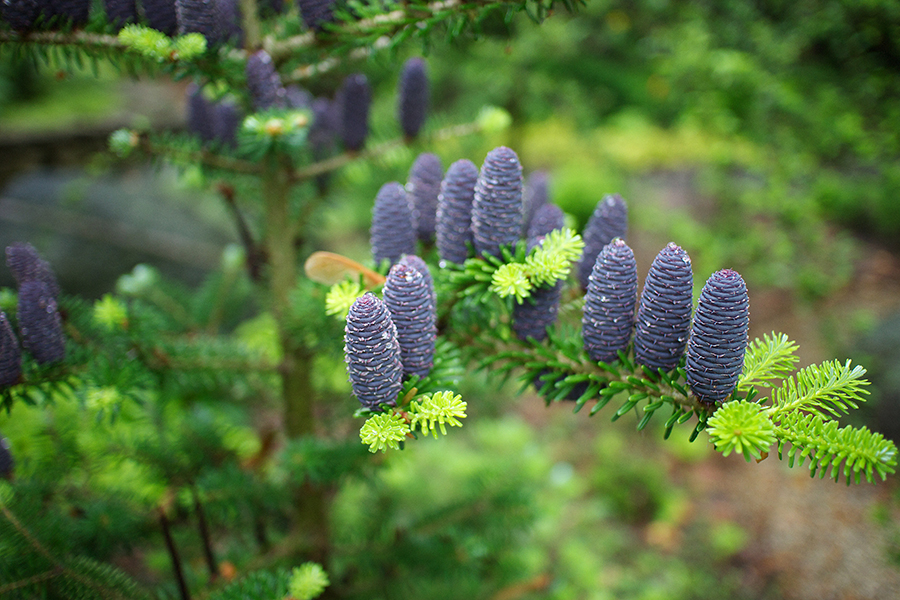
I don't know what tree this was but I loved this little starfish-like cluster of pinecones.


All of the glass art around the garden was made by local artists. I thought it looked quite nice in this bed.


Have you visited any great gardens this year?

SaveSave

Labels: , ,

29 June 2017

A NEW WAY OF THINKING ABOUT STRUCTURE IN THE GARDEN

When I hear about structure in the garden, my mind immediately goes to what I consider the backbone of a garden design: trees, large shrubs and structures. These typically create the framework around which the rest of the garden falls into place.

But a relatively new-to-me plant has me rethinking the idea of where structure comes from in a garden. I don't know its name (and if you do, please enlighten me because I've been looking), but it's some kind of perennial allium. I received it as a small plant from a woman whose garden I visited a few years ago (she has a small annual plant sale) and I didn't notice it having particularly noticeable bulbs, although as an allium I'm sure it has some kind of bulb lurking under the soil. 

Here's what it looked like the first time I spotted it in her garden. 


There are a lot of plants in that photo but I don't even need to tell you which one I'm talking about because your eye is immediately drawn to it. 

Mine is obviously much smaller and is just starting to flower (bees seem to love, by the way). 

I'd say it's about 30 inches tall and it's thick, hollow blue stems are unlike anything else in my garden. What caught my attention the other day is that the stems have arranged themselves in a very artistic crossing pattern that is quite pleasing to my eye. 


But the architectural form of this plant makes it more than a focal point; it provides structure. I love loose, natural and even wild perennials that have a tendency to flop (but not too much, please) and go their own way, but without structure, they can look messy and out of control. Add in a structural element, like this strong-formed allium, and it all starts making sense.


In my garden, above, it's near the 'Orangeola' maple, which in itself provides structure, but to me, it's the allium that makes the structural statement. (And the bare spots you see are where the rabbits have done their worst.)

And I think you'll see it does the same elsewhere. You can barely see it in the photo below but I think this garden would be much less successful if it weren't there.


It's not the typical kind of plant one associates with structure, but there's no doubt that's what it provides. Sometimes you never know what a plant can do for your garden until it's there.

Labels: , , ,

15 July 2016

THE VALUE OF SEEING YOUR GARDEN THROUGH SOMEONE ELSE'S EYES

I've extolled the virtues of garden tours many times here. I believe there is nothing more inspiring than experiencing a garden other than your own. It's hard for me to think of a time I've toured a garden and not left with a design idea I would like to incorporate into my garden or a plant I absolutely had to have.

Something that's right in my garden right now: The first 'Cafe au Lait' dahlia bloom.

And yet, I rarely invite people into my garden any way other than through this blog (which is much different from really seeing a garden). My mom comes to see my garden from time to time and the occasional neighbor, but that's about it. In fact I actively avoid having people in my garden and have turned down tour requests on a handful of occasion because I know there are parts of my garden that are far from perfect. And when I look at my garden through someone else's eyes, all I see are bare spots where plants have failed, weeds plotting a full-on garden coup and design mistakes that you'd think I would have stopped making by now.

So it was with some trepidation that I gave my blogger friend Linda from Each Little World and her husband Mark a tour of the garden last week. I visited their amazing garden last year and I was happy, although nervous, to swap roles.

But the pressure is (mostly) off when you have dedicated gardeners visiting in a casual situation. They understand that weeds happen and plants get moved and bare spots develop. They also understand that sometimes things just get a bit overgrown. So really, I couldn't have asked for a more understanding audience and I thoroughly enjoyed our visit (while alternately cringing at weeds I missed).

The best looking spot in the garden right now is the annual border along the house. Everything in this border other than the  'Bergaarten' sage and the begonias was grown from seed (or tubers, in the case of the dahlias) by me this winter/spring.

The window box is finally starting to fill in and show signs of "spilling."
What I didn't expect to come from the visit, was for me to get something out of it beyond a chance to catch up with friends and talk plants. And yet, I saw my own garden through another person's eyes. It's interesting to watch other people in your garden. To see what they are drawn to first, what makes them pause, and what they ask about. It's the best way to gauge the flow of a space that I can imagine. Just watch people experience your garden.

Linda, Mark and I also had a chat about what I call the Circle Garden (it's an oval, but that has no ring to it). It was the first garden I really started from scratch on a year or two after we bought our house and I put a ton of work into the bones of it. I still like it and think it has the potential to be a real star in the garden, but what's there now is not working. I told Linda and Mark that it started as a vegetable garden with some ornamentals but then I realized there wasn't enough sun for tomatoes and I built a dedicated vegetable garden. And then Mark pointed out that since much of the rest of the garden in that area is shades of green, perhaps something wildly colorful might work. And from there the three of us tossed around ideas.

I pointed out this Aralia 'Silver Umbrella' to Linda when she visited. It was new last year, but I love how it is growing so far.

The result of that visit is that I realize that the Circle Garden has been bugging me for a long time but I've been ignoring it, and for the first time in years, I'm excited about the possibility of starting completely from scratch there.

Last year I planted this 'Sapphire Indigo' clematis and this year it is growing beautifully. It may be my new favorite. 
It's the kind of inspiration I usually get when I visit a garden. Little did I know it would work the other way too.

So I'm amending my drumbeat encouraging people to visit other gardens to add that it's equally important to invite people into yours, warts, weed and all.


Labels:

01 July 2015

A FANTASTIC JUNE IN THE GARDEN

Last week I had to go to Newport, Rhode Island, for work, and although business travel isn't high on the list of things I want to be doing in summer, it was a pleasure to be in such a beautiful city.

Before I left I gardened like a mad woman to get all the major jobs in the garden finished before I left. This meant pulling out as many weeds as could, mulching, planting everything still left in pots (and then I found another handful of plants sitting around). 

When I came home, I was rewarded by a garden that is looking as good as it ever has. Even though there isn't much blooming right now—lady's mantle, nepeta, a few clematis and a handful of other things—the foliage on all the plants is looking healthy comes in the widest variety of greens a person could imagine. 

I took advantage of the garden looking good last weekend to run and take a bunch of photos. It's such a pleasure to be in a garden that doesn't appear to be crying out for maintenance, even though we know there always weeds to be pulled, plants to be moved and planning to be done.

I'm so happy with the new garden area that I created last year. Here's the view of it from near the garage.

nepeta

The east side of the property has three arrowwood virburnums that I planted three or four years ago. Two winters ago they were decimated by deer, but I fenced them off last winter and now they are really flourishing and providing the screening we were looking. Sadly, I've just read that the viburnum leaf beetle has been spotted just 20 miles from us and their favorite thing to munch on (and usually kill within two to three year) is arrowwood viburnum. There's not much to be done about it other than cross your fingers.

arrowwood viburnums

On the far end of that bed is a shadier area where 'Tilt-a-whirl' hosta and ligularia rule the roost.
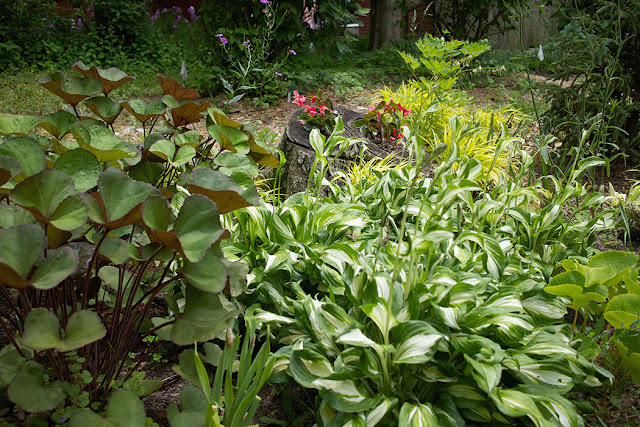
Tilt-a-whirl hosta and ligularia

I'm growing a climbing hydrangea up the north side of the garage and even that is looking healthy although they are notoriously slow growers. I'm happy to see a few flowers even. I should add here, that you should think very carefully about growing a climbing hydrangea up your house or garage because they can really damage wood siding. Since our garage is pretty basic, I'm not worried.

Climbing hydrangea

The other side of the circle of grass in the side/back yard was modified a little last year and that too is looking pretty good. 


This patch of nepeta is kiddy corner to the patch I showed you above and it creates a great color echo in the yard.

nepeta and lady's mantle


This clematis (whose name I have forgotten but it has a label that I will check) is growing up the skirting on the deck.

clematis

I picked up some begonias on sale and planted them under the serviceberry tree and I couldn't be happier with how that worked out.


Over the years I've come to learn just how adaptable most hostas are. I stuck this 'Abiqua Drinking Gourd' in on the back side of the main garden and I love the contrast in texture.

Abiqua Drinking Gourd hosta

Nearby there were a few holes in the garden so I stuck in some petunias. Because there are taller plants around them, you can't really see them until you get close to them an it's a nice surprise. There's also one of several caster bean plants in there that I put around the garden. I hope they take off soon, but we'll need much warmer weather for that to happen.


Along the path to the garage this garden of blues, chartreuse and purple foliage plants is starting to come together.


On the other side of the house, the shade gardens have some filling out to so but so far they are looking OK.


In the distance you can see my first climbing hydrangea.


 Here's a better view. It is nowhere near as impressive as my mom's (which I showed you on Facebook the other day) but hopefully someday it will be.


This is the plant of the year, 'Biokovo' geranium.


 My little stone crane amongst the Egyptian walking onions.


 The annuals in the front patio bed are starting to come together.


And one last shot of my new Aralia 'Silver Umbrella.' The hosta ('Elegans', I think) keeps trying to eat it so I keep trimming off leaves.


 How's your garden looking?


Labels: , , , , , ,

26 June 2015

GARDEN TOUR: A FAMILIAR GARDEN FULL OF SURPRISES

I love looking at photos of gardens. I study them and after a while I think I know them. I've been following Linda's blog Each Little World longer than I've been following any other garden blog and I feel like I've become close friends with her Madison, Wisconsin, garden. 

But a couple weeks ago I had the opportunity to see her gorgeous garden in person and what I found was that, although I recognized parts of it from photos, it had a completely different feel than I expected. What struck me most, was the variation in the topography on Linda and Mark's very large city lot. Linda told me that topography is part of the reason they chose the property, which had no garden whatsoever when they bought it a couple decades ago.

The undulating terrain offers so much interest and creates garden areas with distinct personalities. What I also discovered is that Linda and Mark have a most interesting collection of plants, shrubs and trees. Several of them have been added to my list.

I MUST have this Carex 'Beatlemania'. It has the most delightful thin foliage and it made the most beautiful groundcover. It was growing on top of a low stone wall, so it was the perfect height for petting and admiring.


At first I had no idea what this caged plant could have been, and then Linda told me: It's an oak sapling (or maybe technically it's still in the seedling stage). A giant Bur oak (which a local historian believes is from a time before Wisconsin was a state) marks Linda and Mark's driveway and last year three seedlings made it through winter. This one made it through the following winter as well.


These pinecones caught my eye from 25 feet away. They were absolutely gorgeous. I'll have to ask Linda the name of the tree again, as I have forgotten.


Alongside the driveway is a stunning forest pansy redbud. Linda explained that it has suffered some winter dieback over the years, but the pruning from this damage has created an interesting, open shape that is equally nice to look at from afar and from underneath. The leaves are the most lovely shade of purple with green veins. 


Linda's 'Golden Shadows' dogwood is so lovely. I struggle so much with growing these.

golden shadows dogwood

The fence along the back of the property is one of the first things I fell in love with on Linda's blog. It was designed and built by Mark. The property behind it is for sale. What a bonus for new owners to have a back yard that shares this lovely feature.


I loved this apricot foxglove that stood by itself among a great selection of foliage plants.

lone foxglove

This weeping  Japanese katsura, Cercidiphyllum japonicum 'Pendula', was so lovely in a back corner of the garden. They prune it to be able to walk under and it was such a charming moment. I intend to add one to my garden some day.

japanese katsura tree

Unless I missed, I don't think there is any grass on the property. Everything is connected by a series of paths, some rock stepping stones, some mulched, but all wheelbarrow accessible. When you walk around to the back of the house, the most phenomenal (and large) pond fills your view. A waterfall leads into it creating a lovely sound.

idyllic back yard pond

There are upper and lower areas to the pond.

upper pond

Linda and Mark took great pains to select appropriate rocks for around the water feature. The result is a completely organic feeling. Sometimes ponds feel a little contrived (which is not always a bad thing) but this one really feels like it was always there.

organic pond

I so enjoyed meeting Linda in person and touring her beautiful garden. What a treat to see a garden I've been admiring for so many years. You can see more of Linda and Mark's garden at their blog, and I highly recommend the "My garden odyssey" category of posts that detail the making of this great garden.

Labels: