The Impatient Gardener

20 June 2017

THE FASTEST & EASIEST WAY TO MAKE YOUR GARDEN LOOK BETTER

Hi friends! I just wanted to let you know that Troy-Bilt provided me with the tools I'm showing you in this post and compensated me for my time. Of course all opinions are my own.

You've seen these tips for quick cleanups of your house, right? Like the 5-minute thing where you know company is coming over so you quickly dump everything in a laundry basket to pick up?*

There is a gardening equivalent of this: The one thing you can do to make your garden look a million times better even if you don't have time to do anything else. What is this magic gardening trick, you ask? Edging.

I'm a fan of natural edges cut into grass to define beds because they are the easiest to keep looking neat and tidy and they keep the focus on what's in the garden, not what's surrounding it. (Seriously, don't even think about doing a rock edge without understanding the weeding frustration that comes with them.)

But they do need to be created and maintained. I've done this in many ways, with various levels of mechanical assistance. Most of my beds were originally defined with a flat headed spade and a lot of leg power. You can also use a half-moon edger for this. This works, but it's tiring. Then a few years ago I got an electric edger, which helped cut the edge. It was better than using a spade, but not particularly effective. But now I've found what I believe will be the last edging tool I ever need: a gas-powered edger.

This is a huge time saver, easily cutting hours off the manual method and at least half the time or more off the electric edger method.

So here are three steps to making your garden look better, fast, without doing anything else.

1. EDGE IT

Edge your garden beds

To properly clean up a garden edge that already exists, you're going to need to cut a little bit of grass away. Don't worry, though, because odd are that your grass grew into your beds by that much in the last year. You can cut away as little sod as you like, so long as you are making a fresh cut or skirting just inside the existing edge. I find it hard to be precise enough to run the edge, so I think it's actually easier to cut a fresh edge.

I used the Troy-Bilt TB554 Gas Lawn Edger for this. I like it because it's compact enough to easily store in the garage or throw in the car (when your family finds out you have an edger you are invited over to "show them how it works" a lot), but there's enough weight to cut into the sod without hopping around, which is what the lightweight electric edger does. There are five blade adjustments and the directions tell you to step down gradually through the blade depths, but my soil is soft enough that I can go for full depth from the get-go.

Gas powered edger

It also has two other features that are very nice but I find myself not using in this circumstance. The first is the ability to bevel the edge in either direction, which gives a really nice look. The second is great for more typical homes in cities. The back wheel drops down, allowing the machine to stay above a street curb so you can edge right along it. If you think freshly edge gardens look great, you have no idea how much a crisp lawn edge along a sidewalk, driveway or curb can raise the bar.

Depending on how hard the soil is, you may have to work the machine back and forth a bit, but again, it just cut through my sod with no problem with me walking at a slow pace. The slow pace was fine for me because I like to be careful with the direction I'm heading when edging beds.

The blade is only on one side, so the direction you have to edge in is dictated by that. It's not a big deal, but if you're trying to line up with another garden at the end, you may want to paint a line with spray paint to make sure you have something to follow.

The edger definitely works better when the soil is a little dryer. That's not something we've had here for a long time as it seems to rain every day lately (when did Wisconsin get transported to Seattle?), but it will work on moist soil so long as it's not sodden. Don't even try to edge in that mess.

2. REMOVE THE CUT EDGE


Don't throw the spade away when you get a gas-powered edger! You still need it. After the edge is cut, go through with a spade and just pop the cut edge off. You could also do this with a trowel or soil knife on your knees, but why kneel when you can do this standing up with a spade?

I like to knock whatever soil I can off the edge before I collect it for composting. Because I was reshaping this bed slightly, I cut a wider edge in some places, so there was a little more sod to remove.

3. CLEAN IT UP


With the edge cut and the sod bits removed, all that's left is a little cleanup. Some soil is bound to end up in the grass and some grass clippings will end up in the trench you've created. The easiest way to deal with this is a blower. I'm starting to amass a bit of a collection of blowers, but there are at least two I can't live without and I think they compliment each other well.

For quick clean up, I love my battery operated Troy-Bilt TB4300 Handheld Blower. Press a button and it turns on. This is what I reach to when I'm done working in the yard for the day and I just need to do a quick run around on the patio and deck.

But bigger jobs require something else. There is a battery life issue to be concerned about with the handheld blower (about an hour with the "eco" mode and less with it on full-blast) and it can also get a little heavy when you use it that long. That's the same issue you'll have with a traditional gas-powered mower. That's where a backpack blower comes in handy. All the weight is carried on your back (and it's amazing how light it feels back there compared to waving your wrist all over the place), and the blower arm is very robot/jet-pack inspired. Basically it feels like you have a giant joystick in your hand. We have the Troy-Bilt TB4BP EC Backpack Gas Leaf Blower and I love it for bigger jobs. Mr. Much More Patient, who is a bit more than a foot taller than I am tells me he wishes it had a longer blower tube because he feels like it's too short for find-tuning blowing direction when he's using it.

After edging, I just blow all the bits back into place or out of the way. If you're edging along a sidewalk this will be even more important because some dirt is going to spray around during the edging process and you'll want to clean that up.


And that's it. Check out the difference in the before and after. I did nothing else other than edge. In some areas a chunk of weeds popped up when I went through with the spade, but as you can see there are plenty more weeds in there. If I had time, I could go through and pull or hoe out those weeds and then mulch the beds and this would be amazing looking. Note: Don't fill the entire trench with mulch. You'll lose that crisp edge and just create a place for grass and weeds to creep in.

I get away with edging all my beds once a year and then neatening them up with a long-handled shears a couple times. Edging again fall would be even better, but sometimes you just don't have time for that. Just like sometimes you don't have time to weed the garden and deadhead flowers before your garden party. Edge it ... they'll never notice.


*Note about the laundry basket thing: I did this once and literally a year later I found a laundry basket shoved in the basement full of things I had been looking for since they went in that basket, so I don't actually recommend this.

Labels: , , ,

12 June 2017

MY QUEST FOR THE PRETTY GOOD LAWN + A GIVEAWAY

Hey friends! This post is sponsored by Troy-Bilt, who sent me a mower to review and paid me for my time. But you know all opinions are my own. As are all the weeds in my lawn. 

I've come to accept that I'll never have the perfect lawn. There will always be weeds in it and it will never feel like a pillow under my bare feet. Because we choose not to use synthetic herbicides and fertilizers, maintaining a pristine yard is more challenging.

But that doesn't mean we don't like a nice looking lawn. We overseed when necessary, fertilize at appropriate times with an organic fertilizer, repair bare spots, hand pull bad weeds where we can (dandelions are at the top of the hit list), make sure to keep the mower blade high enough that we're not scalping the lawn, water on rare occasion if absolutely necessary, mulch clippings onto the lawn and trim edges to make everything look neat.

I want a good looking lawn when I look at it from the patio. Get in close and you'll see lots of clover, a bit of moss in some spots and various other less-than-perfect areas. From the long-view though, it looks pretty good, especially after it has recently been cut.

I have huge respect for people who love their lawns. I'm an admirer of gardens and gardening and to me, lawns are part of that. But for my life, I need a good looking lawn that is maybe a bit (or a lot) shy of perfect. And I need it to look that way without a lot of effort.

I accomplish this level of looks-good-from-the-patio through a bit of work in the spring. This is when the holes are patched, thatch is raked up, big weeds are pulled and, a week or so before Memorial Day, the lawn is fertilized with Milorganite. I also do a very simple form of relieving compaction in frequently traveled areas by sticking my garden fork in and rocking it back and forth (over and over again). Then I spread a thin layer of sifted compost over the top and reseed.

I like a good walk-behind mower for quick mowing just around the house. And this one will pretty much pull you around the yard. All you have to do is steer.

But after that, the lawn is pretty much on its own for summer. The sum total of the time I'm willing to spend it on during the high season is a weekly mowing and trimming. And I like to get it done quickly. Often that means we only mow the areas closest to the house. Or sometimes the weekend gets away from us and we need to do a quickly cleanup before company comes over. That's when a good walk-behind mower is best. We have the big Horse XP tractor for when we're doing the whole enchilada, but that's overkill for a quick job.

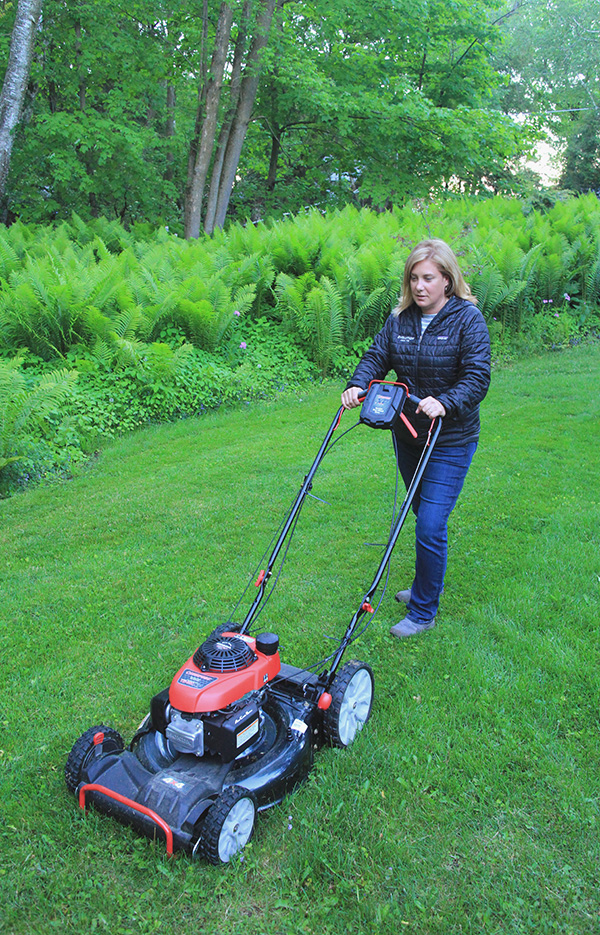
Troy-Bilt recently sent me the TB490 XP self-propelled mower to test. It has all of the bells and whistles you'd expect on a mower like this (bagging, mulching or blowing ability; hose rinse connection; easy pull start, etc.) but I'll it shines in its versatility. It has front-wheel drive (good for maneuverability), rear-wheel drive (good for our varying terrain) and all-wheel drive (for the best of both) and you can easily switch among the different modes with the hand controls. See how those rear wheels are big? That means that when it's in rear-wheel drive or all-wheel drive, this baby has some get up and go, to the point where it can take you a little off guard when you first try it (not in a dangerous way, but in a lace-up-your-tennies kind of way).

What I'm getting at here is that this thing will pull you around the yard if you want it to. Meaning all you have to do is steer. It's the ultimate in lazy-man's mowing, which I think you'll see is right up my alley.

You can check out a quick video review I did of it on YouTube.


Most people I know strive for great looking lawns, and if you enjoy taking care of a lawn, I think attempting to achieve the perfect lawn is a noble exercise. But I think it's OK to strive for a pretty good lawn too. In fact, I'm perfecting the good-enough lawn. Come see my green weeds. I bet you can't spot them from the patio, especially if I get a drink your hand first.

I have great news for you! Troy-Bilt has offered to give one of my readers a $100 Lowe's gift card! Use it to pick up a new mower, buy more plants or whatever you might be needing. How about picking up something great for Father's Day. (P.S. I don't think you'll get the card in time for Father's Day, but I'll pick a winner on Friday so you can at least go shopping!)


SaveSave

Labels: , , ,

10 April 2017

I'M BACK: DISPATCHES FROM TRAVEL HELL

Holy smokes. I'm finally sitting down to reach out to you all to just let you know I'm still around a little bit about what's been happening.

I tend to do little personal updates as part of Friday Finds, but there was no getting to a computer on Friday. Last week I traveled to Savannah, Georgia, for a fun event with all the Troy-Bilt brand ambassadors, a group I'm happy to be included in.

Unfortunately we all got caught up in the Delta airlines mess related to storms on Wednesday. I won't bore you with the whole horror story, but I left my house at 5 a.m. Wednesday and didn't get to the hotel in Savannah until 10 a.m. Thursday. And as if that weren't bad enough, flights were screwed up when I was supposed to fly home on Friday as well, so I didn't get home until Saturday night.

The whole group of garden blogger brand ambassadors. Of course they took this photo AFTER we gardened all day!

This cute herb garden was beautiful but we also added a few plants and cleaned up some beds here as well.

The good news is that I did manage to get to Savannah to help rebuild and expand a children's garden at the Savannah Area Council of Garden Clubs Botanical Garden that was damaged in Hurricane Matthew. Along with Planet in Action and some local Troy-Bilt representatives, our group of 10 brand ambassadors put in several new gardens that should develop into really lovely places for kids to enjoy. I'm proud to be associated with a company that really reaches out to help and not only did Troy-Bilt organize the whole garden makeover, but they left behind a collection of equipment to help maintain the garden and gave the organization another $5,000 to help support the garden.

Officials from Troy-Bilt, Planet in Action and the botanical garden celebrated Troy-Bilt's donation. 

The other good bit was that although I missed out on seeing so much of Savannah, I met some more great people including Amy from Get Busy Gardening who ended up being my travel partner for most of the trip as somehow the two of us kept getting stranded in the same places. After countless hours in airports, about five hours in a rental car, two hotels and a handful of bars, Amy and I got to know each other pretty well and I can assure you, she's a good person to get stuck in a bad situation with.

All of this means that things on the blog got completely backed up because believe it or not, all that travel mess didn't really allow for much time to actually work on things. (It's difficult to type when you're standing in one line after another.)

Allow me to catch you up. First off, the latest One Room Challenge started next week and I'm going to do it again. So later today (or possibly tomorrow) you'll see a post introducing my project (technically you've already seen it but I finally have some more focus on it and it's completely different from the bathroom I did last year.) I'll post the update on Thursday to get on schedule with the official guest participant posts.

With all the travel delays I felt like I was gone for ages but it was really only four days. Still I was shocked to see how much the garden had changed in that time. Daffodils are up all over the place. Garlic mustard weed is popping up all over (and now is the best time to deal with it). In between other projects on Sunday I pruned roses and a few more clematis, set up the temporary greenhouse (affiliate link) and suddenly felt overwhelmed with all there is to do.

More coming, but I just wanted to let you know, I'm still around and not planning to fly anywhere soon!

I am a compensated brand ambassador for Troy-Bilt. But I mentioned this project here because I thought you'd be interested, not because I was paid to. And of course, all opinions are my own!

Labels: ,

10 November 2016

4 TIPS FOR USING A CHIPPER-SHREDDER

I spent many, many hours dealing with leaves last weekend. I say "dealing with" because removing the leaves from the lawn and getting them to their final resting place involves a series of machines and every once in awhile an actual human-powered rake.

My method mostly involves using our lawn tractor to mulch and bag the leaves on the lawn and then to run them over to the chipper-shredder, run them through that, then add them to the compost bin.


A quick break for a disclaimer: Both the lawn tractor and chipper-shredder I have came from Troy-Bilt and were given to me to test as part of my work for them as part of their Saturday6 blogging team. (You can read my reviews of them here and here.)  Of course I've not been told what to say and all opinions are my own. I was not asked to write this post, but since I'm using Troy-Bilt tools in it, I wanted to give you the full spiel.

Because there were a lot of leaves down, it didn't take me long to suck up two bags full with the mower bagger. So I fired up the chipper-shredder about every 10 minutes. Repeatedly.

Which means that I have a whole new slew of tips about using a chipper-shredder. The one I have is the largest and most powerful model that Troy-Bilt makes, but it's still a homeowners' version, as will most chipper-shredders that people use at their homes will be. The point is, don't expect these machines to do what professional model chipper-shredders, like you see arborists and city street crews using, do.

Here are a few tips I picked up from lots of firsthand experience over the course of the summer and particularly into fall.

A closeup of leaves after shredding.

1. A LITTLE BIT AT A TIME

Chipper-shredders have a ton of safety features built into them, which is good, particularly if you've ever seen the movie "Fargo." Pretty much the only ways you can get yourself in trouble are sticking your hands into the machine (which is not easy to do) or not wearing eye protection in case something comes flying out of it (which I've not experienced but I don't take chances with my eyes).

But one sure way to block the whole program up is to try to put too much through it at one time. If you put too many leaves in the hopper at one point, nothing gets sucked through, so in order to clear it you either have to turn the machine off, pull everything out and start over or start poking around with a large stick. Yes, I did that. Yes, I realize you should absolutely NEVER EVER do that. But the first method for clearing is a big drag.

Better you just avoid any of it by putting in small amounts of material at one time. This meant that instead of just dumping the entire collection bag from the mower into the hopper, I would gradually pour it out. This took a little more time but it was much faster than constantly stopping to clear the clog.

2. DRIER IS BETTER

I started working on my leaf collection project first thing in the morning when the leaves were still  covered in dew so they were pretty wet. What I found was the damper the material I was putting in was, the more likely the machine was to clog and the smaller the amount I put in at one time needed to be. Once I figured it this out things went smoothly, but upon further review, I think I would have saved a lot of time if I had just waited for the sun to dry everything off before I started putting stuff through the shredder.

The same goes for other garden waste. I also put through most of what I cut out of the garden. This was harder as stems and other plant material didn't drop to the bottom of the hopper as easily as leaves, but I got around that by doing some strategic loading. Small bundles at a time were needed.

By shredding all my leaves I was able to fit them all in the compost bin.

3. RESPECT SIZE LIMITS

My chipper-shredder can grind up branches up to 3 inches in diameter and it does a great job with it. In fact, I wish I had more branches to put through it because it makes the best mulch I've ever seen. But when they say 3 inches, they mean 3 inches. I put a branch that was probably only 1.5 to 2 inches in diameter in it and it ate it all up, until it got to a big knot, or maybe where it had attached to another branch, which was bigger than 3 inches and it stopped it up good. This, of course, meant  stopping the whole thing, making very sure that all the parts were finished spinning, and then going in there to pull it out, which was not easy.

4. KEEP THE BAG STRAIGHT

I suppose that there are different kinds of collection systems for different chipper-shredders. But on the one I have, there is a long bag that attaches to the chute. I quickly found out that it's crucial that the bag is laying flat on the ground, not twisted. When you start up the machine it's obvious when all is right because the bag will inflate.

I would estimate that shredding the leaves I collected about doubled the time I spent on that project last weekend. That's not an insignificant amount of time. But what I ended up with was lovely, tiny bits of leaves that will break down very quickly and all fit in my compost bin. I've always saved leaves, but before I shredded them, I would just keep them in piles by the compost bin, allowing some to break down by themselves for leaf mould and I'd add the rest to the compost as needed. In either case, the decomposition process took a long time.

My hope is that with everything so nicely shredded, I'll have a lot of finished compost to use by late spring or early summer. If that is the case, the extra work will have been well worth it.

Really good compost requires layering green material with brown material at a ratio of about 1-to-20. Comfrey is a great plant for the compost, so I cut all the leaves off my comfrey patch and layered them on top of shredded leaves. There is so much moisture in these leaves that it was difficult to shred them without it ending up like it had been through a juicer, but they will still break down quickly. After everything starts breaking down, I'll give the pile a good stir to aerate it and add water if necessary.

There are more leaves still to fall, of course, and even though the compost bin is getting pretty full (I've been dutifully layering it with greens as well), I have plans for the rest of the shredded leaves I'll produce. More and more I've been reading about the importance of fall mulching of garden beds, and finely shredded leaves are a perfect material for that. They will certainly be put to good use there. I also like to heavily mulch the roots of some of the less hardy plants I grow, so shredded leaves (which won't blow away) will be great for that too.

Because this is my first year shredding leaves (although we've mulched them with the mower for a few), I won't really know if the extra step was worth it until next year, but I have to think it is.

Labels: , , , ,

01 August 2016

GETTING THE GARDEN VACATION READY

So I'm alive. I feel like I should probably clarify that since I just totally disappeared on you. Once again I got behind on things before I headed out of town to go sailing and then the posts I had scheduled to go up didn't and well, I figured you'd all hang in there and wait for me.

I snapped a quick shot of the garden off the deck as I was running around before I left. 
I was off on my annual summer sailing trip (it was highly successful and full of great sailing, warm Lake Michigan water and lots of sun), but one of the posts I had planned for you while I was gone was about preparing to leave your garden for a week or more. It's scary to do, especially at this time of year when everything is growing so much, but after doing it every year, I've developed a few strategies.

This was the topic of an article I wrote for the Troy-Bilt e-newsletter "The Dirt." We always have someone stay at the house to take care of the animals and the containers, so I'm fortunate that I don't have to worry much about container watering.

I love a bouquet of sweet peas and sometimes the smaller they are, the more charming.

Even though I was running around like crazy before I left (this is my natural state of being before I go anywhere; I am always running around like crazy), one of the last things I did was make several big bouquets for the house. Sure they are a nice treat for the housesitter, but I have a much more selfish for cutting every flower I can: There will be more for me later. Flowers keep producing when they are deadheaded, but lots of spend blooms go undeadheaded when you're gone. By cutting all the flowers I can I get a head start on the deadheading. Sure the garden lacks some color while I'm gone, but who cares? I'm gone!
The 'David Howard' dahlias were going nuts when I left so I cut everyone I could find.

I also made sure to fertilize all of the containers (I don't ask the housesitter to fertilize, just water) and water them really, really well. And the last thing I did was run around (in the dark, for the most part) with the deer spray.

Only one 'Crichton Honey' dahlia was blooming when I left but I cut that too. I can't get over the gorgeous color on this one. 

I don't have a lot coming out of the veggie garden yet, but if I did I would have made sure to harvest any ripe vegetables so the plants keep producing.

So how did the garden fare while I was gone for 10 days? I'll show you the "after" tomorrow.

I wanted to share just one photo from while I was gone. We left to take the boat to Chicago at 11 p.m. Tuesday during the Buck moon. By 5:30 a.m. or so, the moon was still shining brightly while the sun was rising. I took this panoramic photo (and yes it's a real, untouched photo) that managed to capture both the full moon and the sun rise at the same time on opposite sides of the boat. 


Labels: , , , , ,

13 July 2016

PRODUCT REVIEW: A MACHINE TO MAKE GORGEOUS COMPOST AND FREE MULCH

One of my favorite movies is "Fargo." The relevance of this will soon become clear.

I am alternately fascinated by and intimidated by large machinery. I go into using it afraid that I'm either going to break it or myself, but as soon as I start using it, I'm hooked.


And that's about how it went with the Troy-Bilt CS4235 Chipper Shredder. This thing is a beast. Frankly, in my opinion, if you're going to get something like a chipper shredder, I think a beast is the way to go. You want it to do what you need it to do without ever needing to force it. And that means a big machine.

So how big are we talking? Well, in order to see into the brush hopper, I have to stand on my tiptoes. Granted, I'm 5'2" on a good posture day. The branch chute is adjustable, so you can angle it in several different positions. And it's heavy, too. Fortunately, it has large, very sturdy wheels that make it easy to move. When I gave it its first real test, I wheeled it all the way down the driveway and across the grass over to the compost bin with no trouble.

Yep, the first time I tried out this chipper shredder, I was all alone, which is sort of a big deal for me as I usually require several walkthroughs with a piece of equipment before I'm comfortable with it. I read the manual and was happy to see that the starting procedure is repeated on a sticker on the front of the chipper shredder as well as a quick reminder.

Don't mess around with safety with a machine like this. Safety glasses and hearing protection is required. A handy quick-start sticker walks you through the steps of starting and operating the chipper shredder.

Although I'll be the first to admit that I am sometimes lax with safety equipment, this is no machine to play around with. This is where the "Fargo" thing comes in. Anyone who has seen the movie will recall that one character meets his fate at the hand of a wood chipper, head first. And I'll be honest, I could not get that image out of my head when I first approached this chipper shredder. Fortunately this chipper shredder isn't THAT big and there are a lot of safety functions built in. Still, ear and eye protection is required when using this, so much so that it comes with safety glasses.

Having donned my ear muffs and the safety glasses, I followed the starting instructions to the letter: Push the choke all the way over, slide the "gas" over to the fastest setting (the rabbit), and pull. Despite not having a good pulling arm (something I've discussed ad nauseam here), it started up immediately. You have to love that.

This chipper shredder can accommodate branches up to 3 inches in diameter, which is pretty darn big. I didn't have any that large around, but I did have a small pile of 1.5-inch to 2-inch diameter branches. I slid one in the branch chute and the chipper shredder did the rest, seeming to (gently) grab the branch and guide it through. Frankly I was relieved that I could just put it in and let go so my hands never got close to even the end of the chute. (Again, I'm scarred by that movie, so I think I'm probably more nervous than most.)

Branches are "sucked" into the chute so as soon as they start going, it's a hands-free operation. The white bag on the right is large and will hold a lot of material before it needs to be emptied.

The chipper shredder has a large bag that attaches to the outflow area if you like and despite continuing to feed branches in, I was surprised that it didn't seem like it was filling up very fast. And that's the beauty of this machine: It makes the most lovely little wood chips. I would estimate that the pieces were a half-inch or so. In fact, it reduces material so much that I think the bag would get pretty heavy if it were completely full. I was thrilled though, because this is the size of wood mulch that I will drive many miles to find by the bag. If we have enough material that needs chipping I can see saving a ton of money on mulch.

Branches were reduced to nice half-inch sized chips, perfect for mulch.
Leaves and brush were chopped into lovely tiny bits that should break down extremely quickly, giving compost and leaf mold a big head start.
With the branches dispensed of, I tried out a few other materials in the larger hopper, which works on a gravity feed. Some dry leaves on the top of the pile were dispensed with quickly. This will make composting and making leaf mold an absolute dream and I expect it to cut the decomposition process down by many months. I also tried freshly cut comfrey stems and leaves. Comfrey has very thick, water-filled stems and fuzzy leaves. I wasn't sure which chute would be more appropriate for it, but it seemed to work better to put it in the branch chute. What came out was sort of a gelatinous goo and the machine didn't grab it as easily as it did the dry leaves and branches.

Then I put some half-composted stuff in the big chute. This was mostly damp, decaying leaves plus decaying green material. It didn't really go well. In addition to getting caught up on the way down the brush chute, what came out looked more like the leftovers from a juicer. In fact, I ended up pulling out a wad of material that didn't seem to want to go through, AFTER the engine was shut off and after waiting a little bit just to make sure everything was done spinning. (Again, abundance of caution caused by watching "Fargo" too much.)

What I deduced from this experiment was that dry materials are best. Damp, partially decomposed material probably isn't the best.

I'm certain that this chipper shredder will be in frequent use in fall when we clean up leaves (the idea of all of that goodness breaking down in time for spring use in the garden is thrilling to me) and collect fallen branches and in spring when we do tree pruning. It's going to up my composting game big time and I can't wait for that.

I'll just limit my "Fargo" viewing for a bit beforehand.

Disclaimer: I am a member of Troy-Bilt’s Saturday6 Program which provides compensation to me, and in the case of product reviews, tools or equipment are provided to me at no cost for the purpose of providing an evaluation and sharing my honest opinions.

Labels: , , , , ,

28 June 2016

THE WAVE OF THE FUTURE (aka A REVIEW OF A VERY COOL HANDHELD BLOWER)

If you've read my power tool reviews before, you've probably picked up on a trend: I like power but I like it when it comes easy. What I'm about to say makes me sound like a pathetic girl, but I hate pull starts. I'll use them when I have to, but I feel like my arms aren't long enough to do it properly. That is probably ridiculous as I think I have relatively normal arms as far as length goes, but suffice to say, if I can avoid a pull start, I will.

In fact, why in the world can't I just push a button and have the thing turn on? Guess what? I can and so can you.


For me, that's the best feature of the new Troy-Bilt Handheld Blower powered by CORE (technically the TB4300): Squeeze the trigger and it's on. Squeeze it harder and it blows harder. Lighten up on your trigger finger and it blows softer. This seems incredibly obvious, right? And yet, this is the first power tool I've used that is just that simple.

CORE is Troy-Bilt's new battery-operated line of machines. It includes the blower, a hedge trimmer a string trimmer and, soon, a lawn mower. All of the machines operate off one pretty large battery, so you can save money by only buying the power tool after you have a battery and a charger. The blower kit, with a battery and charger costs $279, but if you already had the battery and charger you could pick one up for $179.

Doesn't everyone use their leaf blower barefoot?

As part of Troy-Bilt's Saturday6 blogger team I gave the blower a test after fully charging up the battery. Actually, Mr. Much More Patient snagged it before I could even get my hands on it and do you what the first thing he did was? He turned it on in our kitchen, opened the door and blew out the dog hair tumbleweeds.

You may be inclined to use this anecdote to judge my cleaning skills, but in my defense this happened during the peak of shedding season in our house (with Newfoundlands and dogs with undercoats it's called blowing coat for good reason), and even daily vacuuming can't keep up with the hair for a couple weeks in spring. No, I shared this story with you because it really says something about this leaf blower: It's battery operated, which means you really can use it inside, unlike gas-powered blowers (which I once read are some of the worst pollution offenders). Now, I don't actually recommend using it for this purpose as I learned that for every piece of hair that goes out the door, three go up and float down, which is generally not a good thing in your kitchen.

Love those lights.

I will also admit to being a sucker for good design, so forgive me for a minute while I wax poetic about lights. Yes, lights. The lights on the blower ramp up as you use more power. It's pretty, but more than that, it's practical. I won't say it's a light machine because the battery has some heft to it. But with the battery inserted, it is well balanced and not difficult to wave around while using it. It is certainly lighter and easier to handle than the gas powered model we previously used.

And of course, there are great benefits to not having 100 feet of electrical cord dragging behind you like you do with electric blowers.

I can't tell you how long the battery lasts from personal experience, but I just don't use a blower for long periods of time. In our yard we use it as the last step in cleanup, blowing debris and grass clippings out of garden beds and off the driveway and patio. We've recharged the battery, but not because it was dead, just because we figured it was a good idea since we'd used the blower several times.

This little video gives you a quick idea of what the CORE blower can do. Mr. Much More Patient starts it in Eco mode then pushes the Boost mode for more power and then decreases the power with the trigger when he gets near the plants. The deck was covered in tree bits but unfortunately it's a little difficult to see them.


As for power, I love how much you can control it. There is an Eco setting, which feels a little puny to me, but honestly it'll do just fine for most blowing. Tap the Boost button though and you get serious power. Of course you'll drain the battery faster that way so there's a trade off. I like that I can scale way back on the power when I'm around delicate plants. The other thing that is nice is that changing from more power to less is smooth, unlike other blowers that seem to rev out of control. If you've ever had your neighbor use a blower while you are sitting out enjoying cocktail hour and all you hear is the blower revving up and down, you know how annoying that is, and not just because it's interrupting cocktail hour.

I love the technology behind this tool. As we know, batteries are the future: Cars, phones, computers ... it's all about batteries. I feel like Troy-Bilt has really stepped into the future with this one.

Disclaimer: I am a member of Troy-Bilt’s Saturday6 Program which provides compensation to me, and in the case of product reviews, tools or equipment are provided to me at no cost for the purpose of providing an evaluation and sharing my honest opinions.
SaveSave

Labels: , , , , ,

31 March 2016

10 SPRING JOBS TO GET YOUR GARDEN IN GEAR

I love a good to-do list.

For the most part, April is the first real opportunity to get back in the garden in this area and although this week is cold and wet, soon it'll be time to clean up the yard. So in honor of tomorrow being April and my love of to-do lists, here's a list of some spring cleanup chores.


Affiliate links may be used.


1. CUT BACK PERENNIALS
Be careful when cutting back perennials left standing for winter. You don't want to damage new growth like on this sedum.
 Anything that wasn't cut back in fall should be taken care of now. For plants with stiff stems, such as echinacea, they will often just pull straight out. Other plants with lots of foliage, such as pulmonaria and lady's mantel, just sort of collapse over winter so I lift up the leaves and chop them back as close to the crown as I dare, being careful to look for new growth. Grasses are another plant to be careful when cutting back. If you cut off any new growth when cutting off the dead bits, you'll have grasses without tips, so a little caution is in order.

This hakonechloa is due to be cut back. I'll be careful to check for any new shoots that may be hiding under that mop and not cut them off. 


2. PRUNE CLEMATIS
Since my current clematis count is somewhere in the mid 20s, this isn't a small task for me, but more and more, I've been planting group 3 clematis that simple need to be cut back to a couple buds above the ground. In that case the bigger issue is trying to remember where they are all planted. Group 2 clematis, often the large-flowering varieties,  require a different treatment. I follow a rule of thirds with Group 2s, leaving one third of the stems untouched, lightly pruning another third of the stems and trimming the last third of stems almost to ground. I also take the opportunity to rearrange the stems, usually cutting off the twining bits and reattaching them with ties to whatever support they grow up. I only have one Group 1 clematis, and these are generally not pruned. Because it is a good grower and I'm afraid it may eat my new magnolia tree, I prune it lightly right after flowering, which is very early in the season. If you don't need to contain the growth, then you needn't prune them other than to remove dead bits.

'Guernsey Cream' may be my favorite clematis. It's a Group 2 so I use a rule-of-thirds approach to pruning it in spring.


If you don't know what kind of clematis you have, don't prune it at all. All of them will be OK without any pruning, at least for a year, it's just that the blooms may be much higher than you'd like and the vine may be a bit tangled. Try to identify what kind it is when it blooms so you know what to do next year. Several years of not pruning will lead to an unsightly clematis.

The exception to this is with new clematis that were planted last year. Regardless of what group they are, I think it's best to cut these back like Group 3s, which allows the plant to put more energy into the roots rather than producing flowers. You'll sacrifice some of this year's show, but it will be worth it for the long-term health of the vine.

I also fertilize my clematis when I do my spring pruning. I use Espoma Rose-Tone, and just use a small amount around the roots, watering it in well.


3. PRUNE (SOME) HYDRANGEAS
I already pruned the big Hydrangea paniculata 'Limelight' in my yard and I should have done the others a month ago, but there's still time. This hydrangea puts on amazing amounts of growth, so you can prune it back to 1 to 3 feet and it'll be beautiful and big. If you'd like it larger, prune less.

Last year I didn't cut the Limelights by the deck back by much because they were relatively new shrubs (the before and after follows), but this year I'll cut them back a little more severely. They have grown enough that they flower above the deck handrail now.

Before pruning
After pruning


For the so-called smooth hydrangeas in my yard—Hydrangea arborescens including 'Incrediball,' 'Annabelle' and 'Invicibelle Spirit'—I prune them back nearly to the ground. This excellent pruning guide from Proven Winners recommends leaving some stems as a framework, but I rarely do that.

Bigleaf hydrangea (Hydrangea macrophylla), lacecaps (Hydrangea serrata) and oakleafs (Hydrangea quercifolia) shouldn't be pruned at this time of year, with the exception of removing dead stems, which can and should be done any time of the year.


4. CLEAN OUT THE GARDEN
Leaves that fall in autumn can create big mats in the garden that can make it difficult for plants to emerge. I like to clean up the garden, clearing the way for plants to grow and allowing me to keep a close eye on what is growing. It's easy to spot small weeds when they can't hide under leftover fall detritus. The problem, of course, is that perennials are shooting up all over the place and it's easy to crush new shoots inadvertently when you're standing in the garden to rake it out.

From string trimmer to chainsaw-on-a-stick to high-powered blower (attachment below). Makes spring cleanup much easier!


I like to use a leaf blower for this job because you can't damage young plants and you can clean out areas deep in the garden without having to step in it. You may recall that last fall I tested the Troy-Bilt TB60044 Straight Shaft String Trimmer with the JumpStart engine starter (which gets my vote for invention of the decade). I loved the fact that you can easily swap out a variety of attachments for it and it just so happens that there is also a blower attachment for their TrimmerPlus line, so that is perfect for this job.  I'll be testing out a new Troy-Bilt leaf blower soon that is battery powered and full of cool technology so I can't wait to tell you what I think about it.


5. PULL WEEDS
See that little bugger? That is baby garlic mustard weed and it's already popping up all over the place here. I'm trying to pull it anywhere I find it to get ahead of this garden thug. 
It is amazing to me how many weeds are already thriving in the garden. It's a never-ending fight, but dig out what you can now to make for less work later.


6. GIVE THE LAWN ITS FIRST CUT
When the lawn starts growing, which is will very soon, a first cut will make everything look better. A mulching mower will also clean up all of the other bits and pieces left laying around on it, and it will set the stage for a healthy lawn for the rest of the summer. Just make sure to keep the blades nice and high.


7. PLANT EARLY SEASON CROPS
Sugar snap peas started inside and transplanted into the garden.
Peas, kale, spinach and lettuce are all cool season crops that will withstand plenty of cold weather so an early sowing can get you eating vegetables from your own garden early on.


8. WORK ON YOUR COMPOST
A shot of my compost thermometer last spring, when my pile topped out at 140 degrees! I was so proud and now there's a new standard set that I'll have to meet this spring.
My compost pile goes pretty much dormant in winter but as soon as it thaws out I get out there and start stirring. I'll add the material I clean out of the garden and if it needs a kick of nitrogen-rich material, which is not uncommon after all the carbon-rich leaves and garden waste I threw in there in fall, I add a 5-gallon bucket full of rehydrated alfalfa cubes, which is a great source of "greens" for the compost pile. That usually gets everything cooking again and so long as I stay on top of the stirring and watering if necessary, my pile will be hot by the end of May and I'll be making finished compost quickly.


9. EDGE YOUR GARDEN BEDS
I say this all the time, but I know of no other garden chore that makes your garden look pulled together more than edging beds. A crisp edge will make you look past all manner of garden sins, and if you get a good edge early in the season, all you'll need later is a few touch-ups here and there.


10. MULCH. OR NOT.

I know of no other aspect of gardening that is as controversial as mulching. Whether to mulch, what to mulch with and when to mulch will probably be debated by gardeners until the end of time. The most important of these questions, I think, is what to mulch with. It must be an organic material (that is, no ground up rubber, please), it should break down quickly and you should be careful where you source it from.

I like to mulch with compost, leaf mold or pine bark fines, none of which are particular easy to find in mass quantities. I don't care for large chunks of wood and certainly not dyed wood chips. But this year, I may not mulch at all. Invasive so-called jumping worms have come to our area (they are gross and horribly damaging and more than a little scary and I'll tell you all about them soon), and the DNR is still trying to get a handle on making recommendations on managing them. One of the main sources that could bring them into the garden is eggs in mulch, so I'm very wary about bringing mulch into my garden right now. (By the way, they've also been found in many other states.)

If I do mulch, I will probably use mulched leaves from my yard and my neighbor's yard that have been rotting down for a year or more.

I always learned that if you are going to mulch, you should let your soil warm up first, but there is also a benefit to applying mulch before many weeds have a chance to get going. One thing is for sure: If you are going to mulch, be selective in your sources and keep it away from the base of plants.


AND ONE DON'T
At this time of year, you can probably do more harm than good trudging around your garden. Stepping on emerging perennials is no good and even worse, compacting the soil is really bad. So even though I've just given you a list of a lot of thing that require stepping in the garden, try to limit the traffic there. If you can use a board to distribute your weight when you step in prune something, that will help. It's also not great to dig in wet soil as it can damage the soil structure. So don't get ahead of yourself. Your garden will thank you.

What's your favorite spring garden chore, or the one you hate the most?


This post was sponsored by Troy-Bilt, which compensates me to be part of its Saturday6 blogging team. Of course all opinions are my own!

Labels: , , , , , ,

11 March 2016

FRIDAY FINDS + A PEEK AT AUSTIN

It's Friday Finds time, but first I wanted to share a couple pictures from my trip to Austin with Troy-Bilt's Saturday6 gang last week. Troy-Bilt sent the Saturday6, a group of bloggers who work with them, on a shindig to find out about some new products, explore Austin and do a little good. (Disclaimer: They paid for this trip as part of my Saturday6 contract, but I'm sharing pictures with you just because.)

We took a tour of the Lady Bird Johnson Wildflower Center and although we were about three weeks too early in terms of the blooms putting on a show, it was a pretty fascinating place.

The entry kiosk is entirely self-sufficient. Solar panels on the awning provide all the power, including for air conditioning, which they are able to do because it has a green roof that keeps it significantly cooler than a normal roof would.


For several years, a great-horned owl has returned to the center to nest and raise her young.  She's in the corner in the photo below.


See her head peeking up?

The Texas mountain laurels were blooming.


And the bluebonnets (Lupinus texenis) were just starting to come to life in warmer areas of the garden.

They had very interesting ideas for creating raised and tiered beds.


Unfortunately I can't recall what this plant is, but I loved the combination of blue foliage and orange flowers.

We also spent a day working at a community garden project along with Planet in Action. This was a nice area that sort of fell into disrepair a few years ago, so we, along with Planet in Action, a few county parks employees and a group of very enthusiastic Americorps volunteers (who did a lot of push-ups throughout the day), created some large raised beds, planted grapes and new fruit trees and pruned existing fruit trees that hadn't been touched in a long time.

Raised beds planted and mulched.
This was an example of one of the pear trees we pruned. Everyone sort of divided up and Eric from GardenFork and Kenny from Veggie Gardening Tips and I seemed to end up on pruning duty. It was fun to group prune. Gardening can be such a solitary activity, but we had all had a nice chat while pruning and it was nice to bat around pruning ideas amongst each other. These trees hadn't been pruned in over five years and we had to constantly remind ourselves that you can't undo five years of unchecked growth in one day.
Before pruning.

And here's what it looked like after.
After pruning.
 This next photo is also an after shot although you'd probably not believe that because you can see there's still quite a tangle in there. We were wary of taking out too much of the tree at once (the general rule is no more than 25% of the growth, not counting dead wood), and we had to prioritize the worst offenders. I lobbied hard to take out that older crossing branch that you see in the front of that picture, but was overruled, because it would have left a huge hole in the canopy of the tree. It can and, I'm sure, will be taken out next year.


It was great to get in the garden again and it was nice to help out such a worthwhile project. My fellow bloggers must have felt the same way because we ripped through that project list much more quickly than I think anyone expected us to.

Rochelle and an Americorps volunteer tackle a giant pile of mulch.

 So that was Austin. Now onto what's been good on the Internet this week.

I don't care for corned beef, but plenty of people wouldn't be without it this time of year. Here's what I can only assume is a great recipe for it.

I really enjoyed Matt Mattus's behind-the-scenes look at how the cover of the latest Pith + Vigor came together.

 I love this DIY table.

I'm completely giddy about Michelle Obama's latest initiative.

 Heather is offering up some great March gardening tips to get you going.

That's it for this week. I'm off to the Chicago Flower and Garden Show tomorrow. I'm very excited as I've never been to that one before. I also have some homework to do this weekend. I'm taking an advanced master gardener course on landscape design and one of our first projects is to design a garden for a fictional hospital courtyard. Our designs will be analyzed by professors and students in the landscape architecture program at the University of Wisconsin so I'm alternately excited for real, unbiased feedback and more than a little nervous.

What's on your docket for the weekend?


Labels: , , , ,