The Impatient Gardener

24 September 2014

MYSTERY SOLVED

Well it didn't take long to solve the mystery of what happened to the community garden plots (see the story here). At least one plot-holder complained to the local police (I'm not sure if she filed an official report but she at least made them aware of what had happened) and several irate gardeners complained to the higher-ups at the YMCA, so it's not surprising that someone got to the bottom of it without much delay.

And answer is sort of sad, a little unsatisfying and not something that can really be fixed.

One of our plots following the unauthorized clean up. (Each of these long beds holds three plots.) You can see that plots with flowers don't appear to have been touched.

Apparently it was a fellow gardener who was responsible for cleaning out everyone's plots, including all of their produce. But this gardener is new to the community garden and has adaptive needs, according to the executive director of the Y. Basically, she doesn't understand that what she did was wrong. She said she has been tending and harvesting plots all summer and no one said anything about it. I did notice some produce had been harvested (for instance, I'd see an almost ripe tomato on a vine and leave it there but it would be gone when I would come back a couple days later), but I've learned that a little bit of loss is to be expected. It's not nice but I always hope that it's being done by someone who needs the food.

She did take some of the food from people's plots, but she also dug up the kale growing in our garden and my sister-in-law's plot and attempted to replant it in her own plots. She threw much of the rest of people's produce in the compost pile. It seems she did most of her gardening on other people's plots outside of the operating hours of the Y because no one ever saw her doing any of this. (To my knowledge, there are no rules about when you can garden on these plots.)

The now very sad Redbor kale my sister-in-law was growing was dug up and transplanted to the perpetrator's plot.
According to the Y director, this person really believed that all of the plots were her responsibility. Now of course, this doesn't really add up, but I don't know what sort of adaptive needs this woman has and it's not my place to know.

There are issues with this, of course. For instance, all plot holders must sign a contract laying out a few basic rules that include things about when plots must be planted and cleaned up by, very rough maintenance guidelines, rules about chemical use and an understanding that the only plots you have access to are those you rent and the two plots shared by the community. Obviously this woman did not understand the contract, and it sounds like she probably didn't have the capacity to understand it, so I'm not sure how the Y could have allowed her to sign it.

But all of that is hindsight. It's not really anyone's fault and I assume the Y and the community garden program will learn and adapt from this experience. I do feel better that it wasn't a malicious act by someone.

Perhaps it's best to chalk it up to just one more bummer in summer of gardening bummers. And with that, I promise to stop complaining about the lousy summer!

Labels:

23 September 2014

THE DAY THE GARDEN DISAPPEARED

I'll admit, my enthusiasm for gardening on the plots my mom and I share at the local community garden (part of the YMCA) was lacking a bit this year. With the lousy weather, it was all I could do to drag myself out there to do a lot of tending. But between the two of us, we got our plots planted and kept them mostly weeded.

The tomatoes there were almost as bad as the ones I grew at home, but in another plot I had dozens (at least 50) of gorgeous onions growing. I was very excited because I was planning to keep them and have home grown onions at least into late November and the crop was looking great. There were several softball-sized Walla wallas in there.

They started as seedlings like these and grew like gangbusters but now all my onions on my community garden plot are gone. The mystery: Who took them?

I was a little irritated a month ago or so when I noticed that a few onions had been, um, "liberated" from the plot. But then again, I expect a bit of that to happen when you're gardening out in the open. But imagine my surprise when my mom called me this weekend to tell me our plots were empty.

Everything was gone.

And it wasn't just our plots, it was all the plots. The tomato supports were neatly stacked up and set aside and all of the plots had been rototilled. My mom checked the compost bin and all of the onion tops were there, but no onions, meaning whoever cleaned out the beds helped themselves to all of our produce before they "cleaned" them out.

The kale I was growing was also taken. Other plots had beautiful beans growing that were drying on the vines for winter use. Another gardener had planted kohlrabi and other vegetables for a late season harvest. And with our cold summer, many crops were ripening very late this year.

There are two plots dedicated to herbs and crops for all of the gardeners there to share. Our master gardener group donated two beautiful rhubarb plants to the communal plots. Those, too, have been pulled out and tilled under.

Other gardeners are equally perplexed and angry but no one has a clue who committed this violation of our plots. I suspect it was a fellow plot-holder. Who else would carefully stack tomato cages and till plots (after stealing all of the contents)? If it was just someone looking for free produce they wouldn't have bothered with that.

I really hope I'm wrong. I hope a fellow gardener didn't do this. I like to think that gardeners are better people than that and no matter which way I frame this, I can't think of a way in which this is at all justifiable in anyone's mind.

I love the idea of community gardens. And while I wish the community gardens here were a little bit more like the allottments I see on British gardening television shows, where people have sheds and make tea and hang out, I still think a community garden is a pretty special place. Well, I used to anyway.

Labels: ,

23 September 2011

A tumultuous tomato season

Before I get into today's post, I just wanted to say thank you to you all. The ideas you've been sharing on the office plan have been amazing and really inspiring. I can't wait to incorporate many of them into the office.

Since it is the first official day of autumn (groan), I thought it would be appropriate to talk a little about how my favorite summer crop—tomatoes—did this year. And there's not a lot to talk about.

I knew it was going to be a challenge for the tomatoes this year because we had a very cold and long spring so everything was off to a slow start. Here in zone 5 we have to look for varieties that are quick to mature but even some of those are still full of green tomatoes, and with temperatures predicted to max out in the mid-50s for the next week or so, it's unlikely many more will be ripening.

As you may recall, I grew tomatoes in two locations this year: in the at-home veggie garden and in a plot I shared with my mom at the community garden seven miles west (and therefore away from the chill of Lake Michigan).

The highly scientific (or, um, not at all scientific) study (mentioned here and here) we did between my mom and I when we planted the same kinds of tomatoes from the same source on the same day but treated them slightly differently turned out to be sort of a wash. In the end we both got about the same amount of tomatoes and the only noticeably difference is that my mom's were sort of deformed but maybe a bit larger.

At home, my plants once again succumbed to some sort of blight, although I still got tomatoes (about a bushel of which ripened in the past week).

The state of the tomato plants now might nicely be described as "sad."

Paul Robeson looks truly dreadful.
This is Japanese Black Trifle, which has produced dozens of tomatoes in the last couple weeks. They are smaller, black tomatoes with a really nice flavor. This is one of two grafted tomatoes I grew this year, and while it produced pretty well, you can see it didn't fair a lot better in terms of disease.
 I grew two (expensive) grafted tomatoes this year, one in each garden. The Japanese Black Trifle was quite nice, although I'm not convinced the grafting part of it had anything to do with it. I grew a double tomato—San Marzano and Brandywine grafted onto the same rootstock at the community garden but only got a few San Marzanos and no Brandywines at all. It was fun to try the grafted tomatoes but I'm not convinced they are work the extra cost (which was almost double the cost of the other tomato plants).

The cherry tomatoes (black cherry and snow white) had no problem growing this year, ad you can see from the way they grew up and over the garden fence and they suffered very little in the way of disease but very few of them got ripe. I'm wondering if that's because there was SO much foliage, there just wasn't a lot of sun hitting the fruit.


I have a lot of tomatoes to eat yet in the house and I'm savoring every last one, but I think that will probably be the end of it for this season. Soon I'll be thoroughly cleaning out the beds and throwing away all that diseased foliage (instead of composting it) and before you know it I'll be craving the sweet taste of summer in a tomato while staring at the wretched red cardboard-ish globes that pass for tomatoes in January.

Summer, I miss you already.

Labels: , ,

29 July 2011

Tomato race update: Close but so far

For those who have been following the great tomato race, which isn't officially a race but rather a quest for bragging rights between my mom and I at the community garden plot we share specifically for the purpose of growing tomatoes, I have good news and bad news for those of you on Team Erin.

Here's the good news:

See those beauts? That's just one cluster on my heirloom Legacy tomato. There are about three other clusters like that. The tomatoes are a great size; as big or bigger than the typical tomato you'd buy in the store. My mom  has nowhere near the number of fruits on her Legacy.

Here's the bad news: They've been like that for about three weeks, despite the fact that we've had record temperatures and plenty of warm (and even hot) nights. They just won't ripen (and no, this isn't a green tomato variety).

Meanwhile, my mom's Delicious tomato plant also has less fruit than mine, and she officially gets the price for the first ripe tomato of the year from that plant. But what's weird is that the tomatoes on my Delicious plant are nicely formed and otherwise pretty (although, like their next door neighbors on Legacy, they aren't getting ripe any too fast), while the tomatoes on my mom's Delicous plant are a big deformed (although she reports that they taste delicious ... go figure).

There's still no real way to know exactly what accounts for the differences in the plants.

To recap, the plants were purchased from the same place and planted in the same plot. They are receiving the same water and both are in complete full sun. I planted mine with Tomato Tone organic fertilizer and my mom enrobed hers in plastic for the first several weeks of the growing season.

My mom did sneak a cucumber and a few beans in there as well. As you can see the cucumber is pretty happy.


So here's the question though: Who can tell me why all those tomatoes on my Legacy plant are taking so darn long to ripen? Is there anything I can do to speed up the process?


Here are the past updates:
Tomato Race: I'm behind
My name is Erin and I'm a tomato hoarder

Labels: ,

22 June 2011

Tomato race: I'm behind

Before we get to this post, I just wanted to mention that I did a little tree planting 101 tutorial on The Design Confidential yesterday. Basically you shouldn't do anything you've ever seen a city tree planter do, but check it out if you're looking for some info on planting the framework of your yard.


Late last week, I swung by the community gardens at the YMCA to check on the progress of our tomato experiment going on there. And the news, I'm afraid, is not good.

My mom's Legend tomato (in its protective plastic partial enclosure) is not only bigger than mine, it has TOMATOES! What the heck? Although her Delicious tomato has no tomatoes on it, it too is bigger than my Delicious.

Y1

Y2

Tomatoes on my mom's Legend tomato, above, and filling up its enclosure, below.

Y3

Y4

My Legend tomato. No tomatoes here and it is slightly smaller.


A few interesting shots from other gardens:

Y5

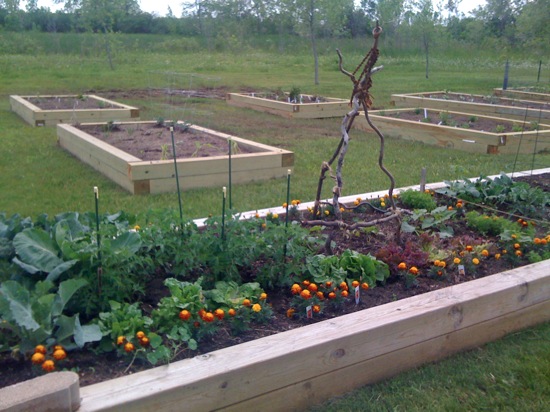
The trellis structure in the middle is just branches tied together but I really like it. Looks arty. And the marigolds brighten it up.


Y6

This gardener put PVC pipe sections next to all his or her tomatoes to help get water and fertilizer to the root zone.


Y7

These are maybe the tallest tomato cages I've ever seen, but the holes in the wire are so small I don't know how this gardener will get the tomatoes out.

Labels: , , ,

10 June 2011

My name is Erin and I'm a Tomato Hoarder

There. I admitted it. They say that's the first step. I don't, however, think I'm alone in this.

For some reason the quest for the perfect tomato, or better yet, bushels of perfect tomatoes, seems to be a pretty common theme among gardeners and I'm right there with them. My home veggie garden is certainly a great improvement over how I used to grow tomatoes, but I'm not satisfied there. Nope, I'm a greedy gardener too.

And it might be genetic, because it turns out that my mother is too. So the two of us are sharing a plot at the community gardens at the local YMCA. I'm a huge proponent of community gardens so I'm happy to be involved anyway, but I'd be lying if I said that's why we ponied up a whopping $25 for the 4-foot-by-8-foot plot. We just want more tomatoes.

Community1

The community gardens at the local YMCA. Each large bed is divided into three plots.


Community2

We worked in a lot of compost and composted manure but I think we probably should have worked the soil a little more because it's not the best. The little Alaska nasturtium in the corner (a leftover I had) for some reason decided to just bloom a billion little yellow flowers and might have burned itself out just doing that.

We're hopeful that we'll do well at the community garden because it's located in absolute 100% full sun and 5 miles farther inland than either of our home gardens (which stay much cooler into summer because of the influence of a rather frigid Lake Michigan).

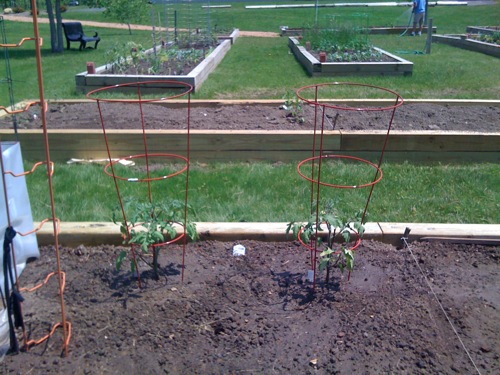
Interestingly enough, we also planted some of the same varieties of heirloom tomatoes, unknowingly. And my mom was anxious to try something she'd read about: enclosing the tomato cage in thick plastic to help retain heat (the top is open so it doesn't fry). So we ended up with a little experiment that we weren't intending: which plant will produce more tomatoes  and which will produce first. They were purchased from the same source (our master gardener's heirloom plant  and herb sale) and planted on the same day. We're treating them identically in every other way.

Community3

Community4

Two of my tomatoes (top) are living their unhoused existences with just basic tomato cages around them, but my mom's is living in it's little plastic enclosure. Any guesses if it will make a difference?


When I went out there earlier this week to water, I would say the plant in the plastic looked slightly larger than my "control" plant. They had the same amount of flowers and looked the same otherwise.

I have five tomato plants growing at home (heirloom varieties Black Cherry, Snow White Cherry, Paul Robeson, Black Krim and a grafted Japanese Black Trifele) and three at the community garden (heirlooms Legend, Delicious and a grafted Brandywine/Super Marzano). The grafted tomatoes are an experiment all in their own right but we'll see if they are worth all the hubbub.

It will be interesting to see how this little tomato experiment ends up. I don't care as long as we end up with so many tomatoes I'm begging people to take them off my hands. That'll be the day.

Labels: , ,