The Impatient Gardener

19 April 2013

A tree that might be worth the chance

I've been spending some time doing lots of research on trees, which is an area I'm less familiar with, because we're about to lose two very special trees. The tree cutters were supposed to come this week but the weather has kept them away.

A March snowstorm took out half of this Cedar leaving it angled precariously close to our house. The rest will have to go.
We'll be taking out the rest of the cedar that was badly damaged (and threatening to eat our house) during a late winter snowstorm as well as the giant birch that is sickly and has needed to be removed for years. I'm especially upset about losing the latter and I'll be honest and tell you I might even shed a tear over that one. 

I will really miss this birch tree.
I have a personal goal to plant a new tree somewhere on our property every time we take one out. Part of the beauty of our property is the hundreds of mature trees and I want to make sure that future owners will be able to enjoy them as well. 

We are having the birch stump ground out so we'll be able to replant in almost the same space. It's a special spot—the main focal point in the back yard—and we've enjoyed having a large three there so we're hoping to replace that with something prominent. I'm not sure what that will be yet. I'd love to plant an American beech (Fagus grandifolia) there because I love the other beeches growing on our property and we are in one of the few places in Wisconsin where they will thrive. But beeches are notoriously difficult to propagate in a nursery situation so it's very difficult to find one of any size.

We're going to wait to decide if we need an evergreen for screening purposes where the cedar will be removed. If we do, it won't be another cedar. The deer adore cedar and there isn't a cedar tree in our neighborhood (which happens to be called Cedar Beach) that has foliage below 7 feet. This is fine for mature cedars because they flourish above the deer-eating line, but it is impossible to grown them big enough to get to that point without a deer attack. Deer can destroy a cedar that's 10 feet or less in one night.

If we don't need the screening, I think this might be an opportunity for a small specimen tree. The location is just out the living room window so it has to be something special.

Venus dogwood
One tree I'm very interested in and actively trying to find is a Venus dogwood. I first read about this tree on Deborah Silver's blog a few years ago and when I read a mention of it elsewhere the other day it sparked a mental note I had saved that this was a tree to look into should I ever have a place to put one. 

First of all, I love dogwoods. Most have a lovely layered branching habit that to me is the perfect combination of found-in-nature casual rambling and strict Japanese-style pruning (if such a combination is possible). Secondly, some, including Cornus kousa and Cornus florida have beautiful four-petaled flowers. Unfortunately they are also prone to a disease called anthracnose, which eventually kills the tree.

Check out the size of those flowers! Dr. Elwin Orton showing off his tree. Rutgers photo
Well guess what Venus, a hybrid developed by Dr. Elwin Orton at Rutgers University, has going for it? No disease issues. Huge flowers (up to 4 inches, they claim). Bloom that lasts for maybe as much as four weeks (at least it does for Deborah who lives and gardens in Detroit). Fall color. Fast growing. Pretty bark. Twenty feet wide and tall at maturity. What's not to love? You can see why Deborah calls it, "the most spectacular white flowering tree on the planet." High praise. 

There are questions with hardiness. It is listed as hardy to zone 6 in some places and zone 5 in others. We are technically considered zone 5b ever since the USDA updated the zone map last year, but I'm wary of that qualification. It only takes one bad winter to cause major damage. Deborah says she has planted 80 of them in the last several years and hasn't lost one, but Detroit is definitely a warmer zone than us.

So if I go down this road and can find a Venus dogwood, it will be with a bit of trepidation and finger crossing. Sometimes that's road that a gardener can't help but take.


Labels: , ,

11 January 2013

PREPPING FOR WINTER ... A LITTLE LATE

Gosh, it's about time for a gardening post, don't you think?

I never really showed you some of what happens here in the winter when it comes to the garden. Winter brings a couple of serious challenges: protecting plants from the freeze/thaw cycle and protecting plants from hungry animals.

A lot of people think that it's the cold that is most harmful to plants, but really it's the continual cycle of freezing and thawing that does them in. If it would just freeze in late November, get a nice thick blanket of snow in December and then stay like that until it melted in March, most plants would be quite content. But that's rarely what happens, and it's even more rare these days when temperatures seem to fluctuate wildly. (It will be over 40 degrees tomorrow up here in southeastern Wisconsin, for instance.)

So some plants need some insulation, mostly at the roots. The best way to manage this is to give the root zone a good mounding of mulch (I love chopped up leaf mulch for this) very late in the season (like late November in our parts). But if you're like me, you might have brushed off that task when it got cold.

It's not too late to help your plants though. And even though the leaf mulch pile is pretty much frozen at this point, I happened to have just the right thing to use for insulation handy: the Christmas tree.

I cut most of the branches off our tree and stuffed/laid them around the more sensitive plants in the garden. In general, I only take extra steps at protecting plants that are either borderline hardy, relatively new (and therefore haven't had a chance to get as established as I would like) or really expensive/slow growing (because I don't want to have to replace them.)

I also often cage these plants to protect them both from wildlife and the local petlife. Our dogs have been trained to stay out of the garden and they don't dare step foot in it for most of the year, but all bets are off when it snows. I can't blame them too much as it's difficult for them to delineate the borders of the garden and honestly I don't worry about it too much once the ground is frozen, but the shoulder seasons are a bad time for big dogs to be tromping through the garden, stomping plants and compacting the soil. They also routinely bound through the garden, so I protect small or delicate plants with cages just to keep them from running them over.

I put the cage (just hardwire cloth bent around a few stakes) around the ginkgo (gingko biloba 'Gnome') in November, but I forgot to come back and stuff it with leaf mulch. So when I cut the Christmas tree apart, I just filled up the cage with soft branches. It won't work as good as the leaf mulch would have, but it will provide some insulation and a little wind protection too.

Winter plant protection -- The Impatient Gardener

Along the path you can see a couple other things I did for winter. First of all, I put up stakes along the path so we'd know where it was when we are shoveling or snow blowing. It's been a long time since we've had a snowfall that was big enough to cover the entire garden, but when it does happen it can be very hard to figure out where the path is and where the plants are. It would be a disaster to run the snow blower over the garden accidentally. On the left you can see that I wrapped the new Japanese maple (Acer palmatum 'Mikawa Yatsubusa') in burlap, held up by a square tomato cage. I really love that little tree but I'm worried about it because our zone can be borderline for Japanese maples and because with the crazy summer we had, it had set (and still has) huge leaf buds in October. I did this same thing with the 'Orangeola' Japanese maple for its first several years and it worked so well that it is now too big to cage. Although I had put some leaf mulch inside the burlapped cage, I also threw some pine tips in there for added insulation. 

On the right side of the path you can see another cage, which I just put up this weekend (whoops). That is to protect the dogwood (Cornus alternifolium 'Golden Shadows' ) that I replanted this spring. Unfortunately I got to it too late as all of the ends of the branches were nipped by deer. I will trim them back to a healthy bud or branch in late winter or early spring (usually March) and hopefully all will be well.

Winter plant protection: burlap and cages -- The Impatient Gardener

Some plants are left to fend for themselves. Picea englemannii 'Blue Magoo' (which is growing painfully slowly, considering it's supposed to end up at 8 feet tall) seems to have established itself well in the past two years, so other than throwing a small amount of leaf mulch around it, I didn't do anything special. I see from this picture that I need to loosen the twine holding the leader to the stake because the trunk is actually a little curved.


Most perennials in my garden are left standing through winter. Studies have shown that plants are more hardy when they are left standing through winter. The downside to this is that it's a lot of clean up to do in spring when you're already busy in the garden. I like to see something in the garden during winter so this clematis, which works its way to the front of the house every summer is allowed to stand. It's a group 3 so in early spring when I do my clean up I will cut it back to the first bud, usually about 6 inches above the ground.

A local commercial perennial grower told our master gardener group that he cuts everything back in fall but lets all the plant material lay where he cuts it to act as a natural mulch. I think that's a pretty clever idea if you're inclined to cut back your perennials in fall.

The one exception I make to the "Let it stand" rule is with free-seeding perennials like Rudbeckia. I make sure to cut those back and remove the plant material early in the process so they don't seed all over the place. Anyone want some Rudbeckia? Trust me, I have some for you!

Leave perennials standing for winter to improve hardiness -- The Impatient Gardener

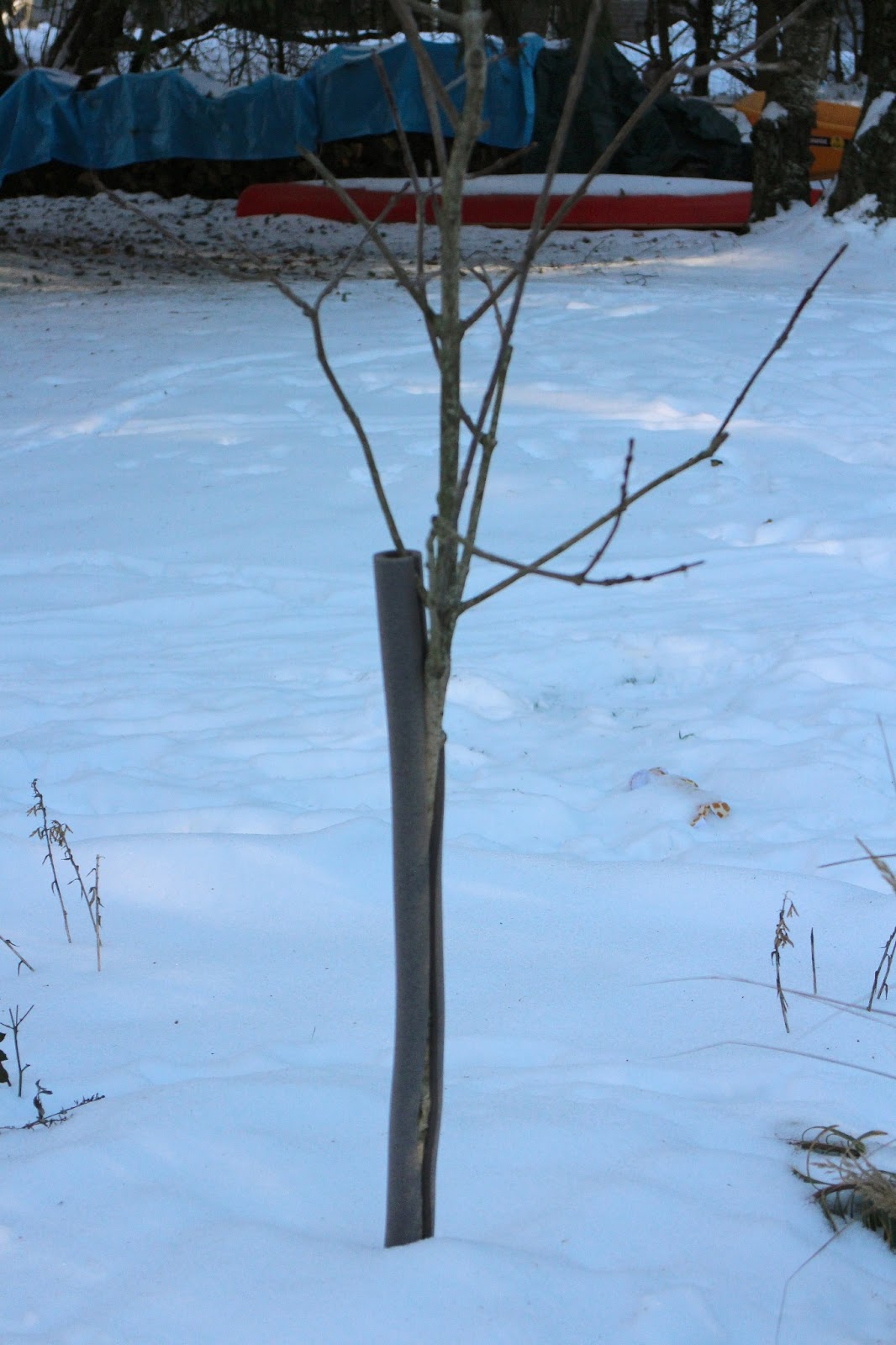
I'm trying something new to protect the trunk of new trees this year. I put a foam pipe insulator around the trunk of the fringe tree (Chionanthus virginicus).  It's not about keeping it warm, rather it will keep little critters from gnawing on the bark.

Pipe insulator to protect young trees from rodent damage -- The Impatient Gardener

Here's what rabbits did to one of my Japanese maples (Acer japonicum acontifolium) a couple years ago when I left the trunk unprotected. The new fringe tree has such a piddly little trunk that a chewing rabbit could do a lot of damage.


One last comment on winter care of plants: It's almost always better to just let snow lay on plants rather than try to knock it off. This is Blue Mohawk soft rush—a great grass from Proven Winners that I really am loving—which will be cut back in early spring along with the rest of the grasses, but the same holds try for shrubs. You'll often do more damage to shrubs by trying to knock off or brush off snow than if you had just left it. There are some exceptions to really icy, heavy snow, but that's usually a last resort, where you have nothing to lose by trying to knock it off because the weight of the snow could bring it down on its own.


How did you prepare your garden for winter? Did you do a better job than I did actually taking care of it before winter was fully upon us? What creative use for your Christmas tree do you have?

Labels: , , , ,

04 December 2012

Winter containers: A bit of much-needed gardening fun

Gosh, here I was reveling in the extra-week-in-between-Christmas-and-Thanksgiving glow and all of a sudden it's December and I'm freaking out a little bit. Every year I resolve to take time to actually enjoy the holiday season instead of scurrying around doing everything, and every year, I end up totally stressing myself out.

The problem is that I'm just not the kind of person who can do things far ahead of time. I like Christmas shopping near Christmas, and I hate thinking about winter and Christmas in the middle of summer, so I'll never be that person who sees the perfect gift in July and actually buys it. The same goes for interior holiday decorating. I can't live with all those decorations for that long, but then I end up decorating when I feel like I should be "enjoying."

This is just the kind of person I am, I guess.

My favorite decorations are the ones I do outdoors. It's my little shot of gardening after a few months off (from the fun stuff at least; cleaning up the garden for winter does not count as fun). I spent most of the weekend working on four containers (three at home, one at work), with frequent stops for various other activities including helping decorate our work entry for the local parade (and handing out candy at said parade later), beach walks, Christmas card photography (third and final attempt), making beef stew and what must have been a lot of other stuff but I can't really remember.

As I showed you last week, I got my red twig dogwood from the field by my parents' house and as it turns out, I didn't cut enough again. Every year I think I have more than I could possibly need and I always seem to come up short. I've found that I prefer them bunched together in pots rather than scattered about so I bundled them together with green wire ties. For the larger pots I bound a stake in the middle that I can plunge deep into the pot for stability. I learned this trick from Deborah Silver, queen of the Christmas container.

Bundle dogwood with wire ties to keep it together -- The Impatient Gardener

Larger bundles get a stake in the middle -- The Impatient Gardener


The urn in the middle of the garden (purchased last year to hold the Christmas tree) has a plastic pot that sits in it as a liner so I don't have to fill the entire urn up with dirt when I plant it. In that pot I just drilled a hole through the center and stuck the stake straight through the pot. Since I had already removed the soil from it, I just fill it up with a small amount of mulch followed by beach sand to hold everything in there. Everything else I just stick straight into the soil left from the summer planting and wait for Old Man Winter to freeze everything up nice and tight (which has yet to happen again this year).

Provide stability to twig bundles by putting a stake through the bottom of the pot -- The Impatient Gardener

After I stick the dogwood in, I fill in with evergreen boughs. Although our property is covered with evergreens, they are mostly some kind of spruce that has a weeping nature to it, which doesn't make for the perky containers I wanted this year. I went to Home Depot where I found that that some of them will let you take the cuttings from the trees they sell, except someone beat me to it. I did, however, find a fat bottom half of a tree in a corner. The top had been broken off it and although she wouldn't give it to me for free, she did agree to sell it to me for $7. My husband also got a great deal in a short/half-bald tree at another Home Depot and I cut them both apart to fill the containers.

Half tree cut apart for greens -- The Impatient Gardener

With the bulk of the evergreens in, I filled in with "special" evergreens including a variegated boxwood and seeded Cedar, all of which I bought in bundles at a nursery. The window box also got a few faux berries (that claim to be waterproof, but I'm suspicious) for a little zing, and the big pot by the front door  got some curly white twigs I found in the faux floral department. They are not meant for outdoor use, which is why they are no long curly, and I don't expect them to last much beyond Christmas, but I thought a cheap shot of white might be nice in that pot.


Variegated boxwood in winter container -- The Impatient Gardener

Dogwood, fir branches and boxwood -- The Impatient Gardener
Here's the container outside of the office (before I swept up the dirt). It could have used more dogwood branches, but I like the texture of the boxwood in it.
Evergreen boughs, dogwood and faux red berries -- The Impatient Gardener
The faux berries really help brighten up the window box.
Christmas urn -- The Impatient Gardener
Midgarden urn, with more variegated boxwood.

Winter container -- The Impatient Gardener

Winter container-- The Impatient Gardener
The white stems and the seeded Cedar give this container a much-needed touch of brightness.

Throw in a few lights, and I was done. I love them all and hopefully they will last well into March when I'll be ready to be thinking about spring.

Labels: , , , ,

26 November 2012

Do you see what I see?

I can't tell you how thankful I am that because of the early Thanksgiving this year we have an extra weekend thrown in before Christmas. It takes so much pressure off.

The rest of the world, though, seems to be full-on into Christmas prep mode. Shopping, baking, decorating and lighting up their houses like crazy. I can't tell you how many fresh Christmas trees I saw strapped to the tops of cars this weekend. How in the world do people keep fresh trees in their house so long? Of course, I'm a pretty poor tree waterer so my trees don't last long anyway.

While everyone else was taking advantage of weekend sales, this is where I was:

In search of dogwood branches


Do you see what I see? Red twig dogwood, my friends. I was traipsing through this overgrown field near my parents' house in search of red twigs. It's getting harder and harder to find them as the field is being taken over by other weedy invasives and ash trees, but with enough looking I can scrounge up enough branches to fill my outdoor containers and the container at work. It pains me to have to pay for dogwood twigs at the nurseries, even though theirs are from dogwood farms and are usually redder and straighter.

I've lost entire piles of cut dogwood in that field by leaving them somewhere and planning to come back to get them only to have them seemingly vanish. This year I left them at the base of the biggest tree in the field so I wouldn't lose them while I was off trimming more.

I used to just stick the branches directly into the soil of my containers but I've learned that they look much better when you bundle them first so I've been wiring them together before putting them in. For the bigger containers, I take a page from Deborah Silver's playbook and wire them to a bamboo or other pole that I plunge deep into the container making the branches much more stable.

I'm now on a hunt for greens to fill my containers, and I've been pretty unsuccesful. I can always find cedar branches, but there are no pines or firs with good branches for filling containers growing in my yard, so I have to supplement my containers with some purchased materials. It's been so hard to find good evergreen boughs this year that I'm contemplating buying a cheap tree at Home Depot just to cut apart into boughs.

Decorating the outside and putting together my holiday containers is by far my favorite decorating of the season, even if it numbs the fingers and toes a bit. All the better to enjoy a hot cup of tea in front of the fire.


Labels: ,