The Impatient Gardener

29 October 2015

A SERIOUS YARD TOOL THAT ANYONE CAN USE

It is a big time of year for yard work. Those of us in the north know that any day could be our last opportunity to clean up the yard before snow and ice descend. And with the garden more or less minding itself at this time of year (at least until we get a good hard freeze) it is the perfect time to really get in there and take care of a few serious yard projects.

Which means it's also a great time to put another cool Troy-Bilt tool to the test. This time around I'm testing the TB60044 Straight Shaft String Trimmer. I know, string trimmers are so, um ho-hum, right? Well not this one because it claims to be a string trimmer but really it's a do-everything little bundle of magic.

First off, it's a four-stroke engine which means, among other things, that you don't have to premix the gas and the oil, it's quieter and a little more fuel efficient. Am I the only person in the world who is a little intimidated by premixing oil and gas? I realize it's a relatively simple process but I've always been afraid that I'm going to do it wrong and wreck something. No worries with a four-stroke engine; you just fill up the gas tank and fill up the oil tank and you're good to go.

I was a branch cutting machine.

This string trimmer comes with the string trimmer bit, but other attachments (and there are many to chose from) are also available. I'll be honest, I don't like using string trimmers and I actually didn't even personally try the string trimmer part of this. Mr. Much More Patient did and I assure you, he is smitten. I, on the other hand, went straight for the good stuff, which was the TrimmerPlus pole saw, aka a mini chainsaw on a long stick. Chainsaws scare me. They are cool but I'm pretty sure you ought to know what you're doing before you operate one. But this is a mini chainsaw that is not at all intimidating. And let me tell you, I had a blast going around and trimming up all the small low-hanging branches on our trees, up to a good 10 feet off the ground or more. It cut through them (I would say they were maybe 3 inches in diameter or less in most cases) with no problem and there was zero flex in the pole so I really felt like I had a lot of control. In fact, I got a little carried away and we spend the next couple hours dragging branches all over the yard.

This shows the reach of the pole saw. Throw in a tall guy and you can really get up there.

Then I tried out the Trimmerplus brushcutter. This is just a really sturdy metal blade that spins like a string trimmer attachment does, but it takes out, well, brush. I have been anxious to reclaim some of the areas under the big trees on our property that have gotten really overgrown and weedy and I went to town with this thing. It worked great, but I quickly learned that this attachment is one that you definitely need to think about safety with. It's loud, so I used ear protection and pants and good shoes are a must because stuff goes flying. In fact, the gator-type protectors they sell would probably be best because even with jeans I had a few pieces of brush that stung a bit.

That area is a such a mess and the brushcutter attachment is the first step in taming it.

There are many other attachments available with the Trimmerplus system, including a lawn edger, hedge trimmer, cultivator, blower and more. But what good are all these cool tools if you can get them started? Ladies, you know what I mean; pulling those strings to start gas-powered tools is difficult to impossible. Honestly, I don't think it's a strength thing. I think it's an arm length thing. I'm not joking; my arms are not long enough to pull the string on a tool and hold it with the other hand. When we first bought our house, Mr. Much More Patient was out of town (and out of the country) most of the time so I sort of MacGyvered a lot of things around the house. And on one occasion, I used a brick, my foot and some sort of yoga pose to start some sort of tool (the specific kind eludes me) that I propped up on a rock. It occurred to me shortly after that I was probably going to get away with something that stupid without hurting myself exactly once and never did it again.

Enter the Jump Start Lithium-Ion Engine Starter, which is the single coolest thing to happen to gas-powered engines in possibly forever, at least if you are a person who has struggled with pull string starting. Charge it up, stick it in the hole on the trimmer, push the button and the trimmer starts. That's it. As silly as it sounds, it's incredibly freeing to know that I can go cut down low branches whenever I feel like it, without having to ask for Mr. Much More Patient's help in starting up the trimmer. It's empowering. I'm not kidding. Wanna see how it works? Check this out:


Alright, I'm gushing. I'm trying not to, but it just make so much sense. You have to like that in a tool.

Disclosure: Troy-Bilt provided the products mentioned here for the purpose of this review, but they didn't tell me what to say. Or, in this case, what to gush about. All opinions are my own, even the ones about string trimmers usually being kind of boring.

Labels: , , , , ,

28 April 2015

A FEW NEW TREES

Don't forget this is the week of all my favorite giveaways. Click here to for the soil knife giveaway and here for the Perfect Garden Hose.
..............................................................

I garden in cycles. Every couple years, I create a new garden area (i.e. last year I redid the back yard), which is a ton of work, and then the next year I think to myself, "Oh I'll just do maintenance this year." What really ends up happening is that I just seem to buy with somewhat reckless abandon because I don't have a specific plan or "budget" (that word is always in quotes when it relates to my garden) to guide me.

From afar, the columnar apple looks like a big stick, but up close there are signs of life to come.

In addition to the ridiculous number of dahlias I bought over winter, many of which are currently in pots in my house as I wait for them to sprout, I also went a little tree crazy at the nursery a couple weekends ago. I brought home one tree that fit in my car: a columnar apple. This replaces a sickly 'Fine Line' Buckthorn that suffered the fate of living in shade for too long and it just couldn't recuperate. By the way, I love the idea of planting small fruit trees right in the middle of an ornamental garden because I think they are beautiful. An apple blossom might be the most romantic flower in the world.

That's what the fringe tree looked like when we planted it back in 2011.

And here it is now in it's new location, looking quite shrimpy with the big beech in the background.

The fringe tree off the deck has been moved. It can't say I didn't warn it. Because I did. Of all the small trees in our yard, that one takes center stage because of its proximity to the deck and prominence in the back yard. I planted it four years ago and I feel like I've been more than a little patient with it. Sure, it's grown a little, but it's still sort of spindly. Worse, it gives me approximately two lame flowers a year and I've not seen any sign of that number getting larger over the years. Sorry, fringe tree, you're going to have to put on a better show than that if you want that coveted spot.

Yes, part of this is my impatience coming through, but more and more, I just don't have a lot of hope for this tree. But it's not the end of the road for the fringe tree. He (or she, and that may be part of the problem as far as the flowering goes) has been moved to a lovely little spot by the creek, which is actually sunny now, thanks to the removal of a couple of very large trees last year.

With luck, we will see a few flowers on 'Ann' this year.

In its place is Ann. Magnolia 'Ann,' that is. She's part of the "Little Girl" series of magnolias that stay quite compact but put on the kind of show you'd expect from a magnolia. They do tend to be a little shrubby, which is not what I'm looking for in that spot, but I was able to find a tree-form 'Ann' that will allow the canopy to hover a few feet off the ground. Truth be told, I really wanted 'Jane,' which has pink blossoms that open to white, but it wasn't available in the tree form and I felt that was more important.

It's sort of fugly, but perhaps 'Ann' will grow into herself. The green stake was temporarily holding the clematis that had been growing up the fringe tree. I had to carefully untangle it from the fringe tree and temporarily tied it to the stake and then reattach it to the new magnolia.
I will admit, when I got this tree home I wondered what I was thinking when I chose it (honestly, I was exhausted and they only had two left to choose from). It doesn't have great shape (it has almost no branches on one side), but once you've borrowed a truck to drag a tree home via a one-hour drive, you're pretty much planting that sucker. Four years from now we might be in the same place, but for now I'm giving it a chance and hoping for the best.

We also added a crabapple, again in the newly sunny area made possible by the removal of diseased or damaged trees last year. Not only will it offer some additional screening from our neighbors to the north, it will be a perfect focal point from our living room window.

To be honest, crabapples scare me a little. Is there any other tree more well-known for its disease problems? And for every gorgeous crabapple I've seen, I can think of two that look terrible and are badly in need of a restorative pruning. I started my search for the right tree by looking for disease resistance and size. I also didn't want one that would get too horizontal.

It looks like very little so far, but hopefully it will become a star in the yard.

I'm fortunate to have an excellent tree nursery near me that has great information online. In their plant reference guide they have a chart on crabapples and I used it to narrow down my choices to two: 'Coralburst' and 'Royal Raindrops,' both of which have excellent disease resistance. Ultimately we went with 'Coralburst' just because we liked the flower color better.

All of the trees are planted and none of them look like anything yet because they've yet to flower or leaf out, which is why the pictures (admittedly hastily taken early in the morning), but I'm hoping the early-season move will ultimately be beneficial to them by shocking them less by the move.

And it's nice to have it done. It's always fun to get a tree, but planting a tree is a chore.


Labels: , , , ,

04 February 2015

A SNOWY WRINKLE TO A DRIVEWAY IDEA

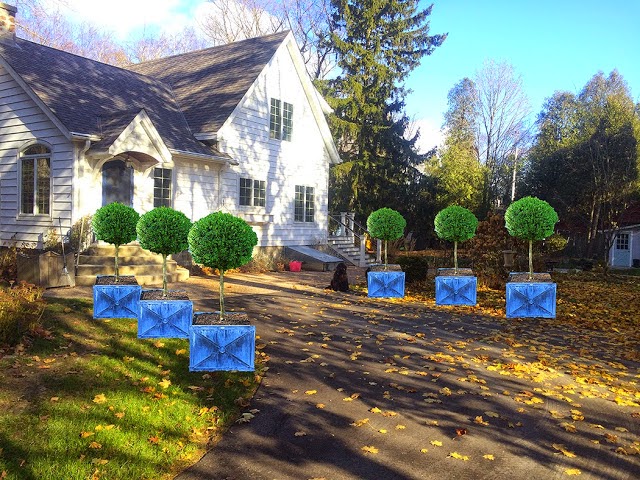
Remember back in fall when I shared my idea to line the apron of the driveway with containerized trees? I wouldn’t say that the reaction from readers was enthusiastic.

I completely understand why. It’s not entirely congruous with the rest of the yard and several people had warranted concerns about the care that containerized trees would require, to say nothing of how much that whole scheme would cost. These are all good points and I’m very thankful for them. Were it not for the rather lukewarm reception to the idea, I might be out hundreds (or, ugh, thousands) of dollars in containers for this harebrained scheme.

I do this sometimes, have a random idea pop into my head and get so excited about it that I get almost obsessed with it, even if I know it’s not a perfect plan. There will be more of these (in fact I’m cooking up another weird gardening idea now but I’m not to the point where it’s real enough to bother mentioning).

A few people suggested doing some nice plantings along that edge of the driveway; perhaps something asymmetrical, but balanced, that would be more in keeping with the rest of the garden. That is an excellent idea, but I knew immediately that wouldn’t work.

Here’s why.


We got our first “real” snowstorm of the year on Sunday. I know it was considered real because it forced the cancellation of most of the flights at the Milwaukee airport. I know that because I was supposed to be on one and I was supposed to wake up Monday morning looking at palm trees and neither of those things happened.

And while the interruption to my travel plans was a bummer, it did allow me to snap a couple photos of the snow situation here, which I wanted to share to show you why permanent plantings won’t work along the apron. As you can see, massive piles of snow are dumped there when we have our driveway plowed. And while perennials seem to do OK buried (some years the pile has extended into the circle garden), no small tree would be able to tolerate that kind of abuse.

Here was a badly Photoshopped idea to illustrate my idea and a real-time photo after the snowstorm.


I haven’t made any decisions about flanking the apron with anything yet. To be honest I have mentally spent a good part of the plant budget for the year (disclaimer: There is no real budget but I have a general concept of when I’ve spent too much and given the potential cost of the containerized tree idea, there wouldn’t be a lot left in the kitty for anything else).


So, for not, that plan remains on the proverbial drawing board, along with several others that range from doable to completely outlandish but very fun.


Labels: , , ,

04 December 2014

BIDDING FAREWELL TO MORE TREES

You won't believe what is happening at our house today. In fact, it was so disturbing to me that I left as quickly as I could this morning without so much as grabbing a photo of it first.

More trees are coming down. Does anyone else get that sick feeling in their stomach when they have to take down a tree, even when you really have no choice in the matter?

We've owned our house for a little over 12 years now and I bet we've taken down 20 trees in that time. It sort of sickens me. I can think of only maybe two that have come down for purely aesthetic reasons; trees that were failing but weren't in danger of falling on anything important.


This all started a couple weeks ago when we discovered that half a maple tree right on our lot line had fallen over in a big wind storm and landed on top of our neighbor's work forklift/cherry picker thing. We paid for the damage (ouch, but what are you going to do) and knew we needed to get the other half of that tree taken down quickly.

We have a great tree guy who I've sung the praises of before, but it doesn't pay to have him come out to just do one tree. Most of his cost is in assembling his crew and getting his equipment out. So if you can lump several trees into one visit the cost per tree goes down dramatically.

Here's a photo of our great tree guy when we had the huge birch tree cut down a couple years ago.
In addition to the half maple, we also had him take down a multi-trunked cedar tree that was hanging way over our neighbor's property. We don't want to take any chances.

Those two trees (or tree and a half as the case may be) are not terribly troubling losses. But the two others we had taken down today are.

One is a relatively large ash tree to the north of the house that, just by chance, we discovered was completely rotten last week. It obviously has not been in the best of health as it has been dropping branches and there's a lot of dead wood on the top, but it wasn't until last weekend that we found that you could stick your finger right into the trunk. I'm not sure what caused this. I peeled off the bark (which was easy to do as it was like a sponge) and did not find any sign of emerald ash borer, an exotic beetle that is decimating the ash tree population east of the Mississippi River and particularly in the Midwest. They leave winding paths under the bark of the tree (see photo below). Once a tree has emerald ash borers there is nothing that can be done to save it.

What damage from emerald ash borers looks like.

I noticed that there was a large nail in the trunk of the tree about 6 inches from the ground. I have no idea why it was put there but I wouldn't be surprised if that created a wound that helped allow whatever claimed its life to enter.

That ash tree probably would not have fallen on our house if it did topple. But it most certainly would have fallen on or gotten entangled with an even bigger ash tree to the east of it. This tree looked to be in mostly good health but almost two years ago our tree guy pointed out to us that it has an 8-foot-long longitudinal crack on the north side of it. We've been watching it carefully and in fall we noticed that two more cracks developed. And this big tree would absolutely crush our house if it came down in the direction in which it's leaning. Our tree guy gave us a really good deal to take it down at the same time as the other trees.

The broken tree that started it all.

Who knows, it might have been just fine for years, but after seeing the damage that half of a smaller tree caused to our neighbor's vehicle, I'm a bit paranoid about the whole idea of trees falling over.

Unfortunately the big tree was also my bird feeder tree. We'll have to find a new place to relocate the feeders to because the birds really need the food at this time of the year.

As for the future, I'm hoping we can find a large tree that will work in the area near where the ashes came down so we can get a start on the trees of the future. We still have a wooded area full of hundreds of trees, but I'm just not comfortable that I know our ratio of trees removed to trees planted is not where I'd like it to be.

The four trees we had removed today needed to come down, I have no doubt. But it doesn't make the sound of chainsaws and wood chippers any easier to bear and it won't make their absence any easier to get used to.


Labels: , ,

13 November 2014

DECORATION FOR THE DRIVEWAY

A few weeks ago I told you that I was contemplating adding some fence panels along a portion of our driveway. I'm still very much in favor of that happening, especially since the house next door recently sold. We don't know what the situation with the new neighbors will be, but odds are they will be around much more than our previous neighbors.

The other idea I've been tossing around in my head for several months now is something to dress up the driveway. You might recall that I was hesitant to have the gravel driveway paved. I looked into the cost of lining it with cobblestones or some kind of decorative edging but that was very expensive. As many of you predicted, I already love the paved driveway and I can't believe we waited 12 years to do it.

But it is a bit blasé. My mind usually goes to plants when I start thinking about how to spruce up an outdoor space and that's where I landed with this quandry as well. But whatever happens next to the driveway needs to be tough as nails. We get a lot of snow and ice in winter and plow the driveway, which pushes the snow well off of the driveway. There is no planting that will stand up to being driven over or plowed in winter that I'm aware of.

See what I mean? It's a little boring, right?
Snoozefest ... especially now that all the containers are empty.
More and more I've been craving symmetry in the garden. There is no one more shocked by this revelation than I am, I assure you. But what I love about our house and yard is that is casual and comfortable so formal symmetry has no business here.

And that got me thinking about a line of planters on either side of the apron, which also serves as the approach to our front door. At first I thought pleached trees (think of free-standing espalier where all the branches grow into one another to create a living, raised wall), but that won't work for winter. But cute little lollipop trees absolutely would work.

So imagine this: three large planters on either side of the apron, situated across from each other (possibly set in an alley of small riverstones or something to avoid having to mow between them, but that's up for debate). In each planter, a short tree with very densely packed foliage, preferably something that turns color in fall. I'm not thinking of anything that approaches topiary territory, for as much I like that look in some circumstances, that would never work in my yard. Rather, I'm envisioning something with a mostly round habit but a bit more free-form than a topiary ball.

I did a couple bad Photoshop mock-ups to better explain what I'm thinking of. Both are a bit out of context since the photos were taken in fall, but hopefully they'll give you an idea of what I'm contemplating.

Here's one with very formal topiaries and I think you can see what I mean when I say that's not right. Ideally I'd like the canopies of these trees to almost touch when they have grown for a few years.


 Here's another with the tree concept a little better represented (although I would want more trunk) with terra cotta pots that don't work at all and are rather distracting.


There are obstacles to this plan, which is why it's been rolling around in my head for several months with no action on my part. Six large planters are expensive. And I guess I've proven that we could build them, but honestly, I don't want to spend all winter building them when I know someone else could bang them out in a weekend. I'd probably call on Ryan who built our kitchen cabinets and the built-in in our bedroom for this project. I'd also have to solve the planter liner issue, because the steel box in the planter we built was a huge unexpected expense. I imagine staining the planters a soft gray, similar to the color of our deck underskirting.

I've contacted a local nursery about suggestions for a tree that might work and they very nicely came up with several suggestions, the most interesting of which is a small cultivar of hornbeam that would be appropriate for pollarding, which is what they suggest for the look I'm going for.

Caring for the trees would be no easy task. Obviously they have to be watered and tended to regularly. They would need feeding as well (something you don't have to worry about with a tree planted in the ground). Every three to five years I would have to root prune them, meaning they would have to be completely removed from their containers while dormant, cleaned of all their soil and pruned at the roots, similar to what you do with bonsai.

And in fall, they would be moved, containers and all, to the backside of the garage where they could winter in a sheltered area free from the ravages of the plow.

It's an expensive and arduous proposition, but I feel like it could completely change the feel of the yard and the entry to our house.

No decisions have to be made yet, but obviously if I'm going to do it, the sooner I can get Ryan working on the planters, the better. In the meantime, I'm just letting that idea marinate a bit.

I have a Pinterest board dedicated to this concept so if you're interested in a little inspiration, check it out here. 

Labels: , , ,

18 February 2014

An unfortunate case of the munchies in my yard

The world outside my door appears to be frozen. Certainly nothing is growing, but I didn't expect things to be shrinking. Sadly, there are a lot of things shrinking in my yard.

The deer are starving. This winter has been so snowy and so cold with almost no relent (we're hoping for above-freezing temperatures this week which would be good for the soul and maybe, just maybe, decrease the size of the snow piles a little) that their food sources are buried or gone altogether.

Like most gardeners, I don't have a particularly good relationship with the deer, but I can't stand to see any animal suffer. What is concerning is that the size of the herds we are seeing are so much larger than in past years. Either the deer that usually hang out in the state park by our house are moving out in search of food or there are just a lot more deer. I fear it's the latter.

Not only are the deer getting even more bold (you would think the 275 pounds of dogs that live at my house would have some effect, but the deer practically laugh at them), they are eating whatever they can reach.

Unfortunately the main targets in our yard were the six arborvitaes we planted to screen the neighbor's house after we cleaned up a few dead trees in the woods. We bought Western arborvitae (Thuja plicata) Spring Grove in part because a neighbor planted several of them a few years ago and they grew quickly and were never bothered by deer even though they were planted along the road where the deer frequently stroll.

I've learned my lesson about "deer resistant" plants many times before, but I never even thought of protecting our trees for winter because they've never been touched by deer before. Usually, if the deer are going to make a meal out of something, they do it pretty early on in its time in our yard.


But now, all six of our Spring Grove arborvitaes have been "lollipopped." That is, the only foliage that remains is the top 18 inches or so. In my experience, the bottom never regrows, but the tree will probably live, but only grow foliage from the level it's at now and up. That isn't so good for when you're trying to block the view from your neighbor's kitchen window.

I'm not alone in this. The aforementioned neighbor with several Spring Groves that rapidly grew to about 20 feet tall suffered the same fate. The bottom 6 feet of his trees have been stripped.

The deer are munching on other things as well. Nothing within their reach is safe. The dwarf apple tree buried in a snow bank has ragged ends on every small branch, all nipped by deer. The same goes for the Limelight hydrangea in front (I'm not worried about this as it's destined for pruning anyway). The damage around the yard is extensive and is only likely to get worse.

That ragged end on the branch is a sure sign that a deer has been sampling.
By they way, I know so many people are buried under piles of snow so you probably don't need to see pictures of more snow. Too bad, you're getting some anyway.

These were taken Sunday, before another 6 inches fell Monday (and proceeded to blow into giant drifts). Testing paint samples on the front of the garage in fall sure looks like a great idea now, doesn't it? No one can say I haven't given the color a great deal of thought, though.


My poor meatball boxwood always gets crumpled in winter. It's hiding under there somewhere. 


Hard to believe this is what it looked like under that snow pile about 6 months ago, isn't it?


Have you noticed the wildlife in your area getting a big desperate with the crazy winter that so many of us are having this year?

Labels: , , ,

05 August 2013

Thinking of a new garden, but it's not my fault

I have a bad habit of adding gardens. I certainly do not need anymore gardening space right now. I find it hard to keep up with the maintenance of what I already have and there are plenty of holes in the existing gardens that need to be filled. Plus I already have my eye on an area in the back yard that I was planning to focus my new gardening efforts on.

The problem is that I don't really embrace "naturalized" areas other than where the ostrich ferns have taken over. I just can't stand looking at mass quantities of weeds. But in some areas I do, if only because I just don't have the time to take on another massive de-weeding project.

And then something changes and sort of forces my hand.

And last week "something" came in the form of the electric line tree cutters.

To be fair, I knew this was coming. I just wasn't prepared for what it would look like. People who live in the city, especially in newer areas where power lines are buried, probably aren't familiar with the crews who come to trim trees around power lines every few years. Seeing these guys, as nice as they are, in your neighborhood is not a good thing. They are hired by the local utility to do the bare minimum required to clear overhead power lines. They aren't arborists. In fact, I believe their contract with the utility forbids them from doing anything beyond the minimum.

Fortunately they seem to have started taking a kinder, gentler approach, probably because of all the irate homeowners stalking them. About a month ago we got a note on the front door telling us that several of our trees needed trimming. I was able to set up an appointment to have them come out and discuss exactly what would be done. The original notice called for trimming an oak and I was able to point out to them that the branches of this enormous tree are so far away from their power lines, even a hurricane wouldn't be a problem. And I was also able to request that instead of topping the two evergreens (spruces, I think) that flank the entrance to our driveway, they just remove them. In fact the trees had already been topped about five years ago and they were already wider than they were tall, but they had continued to grow and the tree trimmers were planning to just lop off another 8 feet.

I was actually happy to see them go as the trees has been ruined with that first pruning several years ago and I didn't want to have to worry about having it done.

Anyway, all of this is a long way to say that those two trees are gone, as well as several branches on other trees, but there's nothing to be done about that. And with those two spruces gone, the end of the driveway is looking rather shabby.

This is the view from our driveway looking at the road (it's a small, one-way private gravel road maintained by all the homeowners on the road). The driveway is in need of some new gravel I think, but in general, it's pretty rustic. Off to the right is where the jewelweed is busy propagating with reckless abandon.


To the right of the driveway if you're standing in the road, you can see where one tree was removed. Unfortunately between the tree behind it not getting any light and the tree guys trimming off many of the branches on one side, you can see what's left is not pretty.


On the left side of the driveway you can see it looks like a swamp. The small creek that runs through a culvert under the road actually pops up there, but everything growing there, save for a few ferns, is ugly weeds.


 Here's a close-up. It's bad news.


So I need to do a bit of gardening there. It's a tough area because it doesn't get a ton of light and it's too far from the house to be easy to prevent deer attacks. I have decided that I can't spend all my time trying to keep the deer from eating everything so at some point I have to draw the line on where things have to fend for themselves and where I'll fight off the deer for them. 

Low maintenance would be lovely, so I'm thinking about some shrubs. Even something that gets a bit rangy would be ok. It doesn't have to be a showpiece, I just want to not look like Bigfoot might pop out at any moment.

It's not going to be a particularly fun project so I'm going to stew on it a little, and maybe put down some cardboard or paper to work on smothering some of the weeds this fall and then try to do some planting in spring. 

But I don't think this should count toward my "new garden" ration.

Labels: ,

02 May 2013

A new view

As I mentioned a couple weeks ago, we've been waiting for the tree guys to remove a few trees from our yard. I wanted to get rid of them sooner rather than later so I didn't have to worry about protecting plants near them and we had some more time to figure out what to do to replace them.

Many of you have commiserated with me about having to remove trees. It's not something we take lightly and it's clear that I'm not the only person who has a connection to their trees.

Taking down the big birch in the back yard was a very difficult decision to make. I remember being in awe of that tree when we first saw the house, but it was clear that it was in failing health and the thought of a very large, sick tree that our house and garage happen to be in the direct path of was making me lose sleep.

It was the first tree they tackled when they got there at 7:30 a.m. (sorry, neighbors) so I watched them remove some of it before I realized some things are better not watched and I went to work. So I looked out the window and saw this:


This tree guy is amazing. He climbs up the tree free hand, ties a few ropes to a couple of branches, rappels  down (using just a knot, no fancy climbing gear other than his harness) and cuts off the branches while the guys below manage them. He doesn't wear a helmet or chainsaw chaps and his eye protection is a pair of sunglasses. It's a little scary but he does amazing work and his crew leaves the yard spotless. And he's always willing to do a couple extra little things if time permits, like cut off a random branch on a tree or grind a small stump.

We had to pay extra to have him grind the massive stump for this birch tree because we hope to plant another three nearby in the future. Yes, you can rent a stump grinder, but having gone that route once because I can tell you it is well worth paying for that service.

Here's a picture from March of the tree:

And here's what that area looked like when I came home:


We have never seen that house from our yard before. Well, at least not that we noticed. We were also surprised about how much shade that tree was providing even without being leafed out. The kitchen is much brighter, which is something I never expected. I think I will probably have to edit a few plants from the new bed off the deck, but I'll wait and see how things do as spring progresses.

The other major change came in our bedroom. One of the reasons we loved that tree so much is that we looked at it from bed, watched birds and squirrels frolic in it and watched it sway (a little too close to the house) in the wind.

This was the view from bed Tuesday morning before the tree cutters arrived.


And here's what it looked like yesterday afternoon:


That's quite a difference, view-wise, and I think it will be even more of difference light wise. I don't think it will still be enough to get me to put window coverings up, but it might help me get out of bed a bit earlier. That's not a bad thing.

The cedar that was badly damaged in the March snowstorm also came down. It was right outside the living room window. We were concerned we would be exposed to the road and our neighbors on the other side when it came down, but I'm actually pleasantly surprised by the view.

Here's what it looked like out the window before:


And here's the after:

One thing we've learned is that projects beget projects, and taking down these trees is no exception. For one thing, there is this little issue to deal with:


That would be the massive pile of wood from the birch tree waiting to be split and stacked. The wood revealed that we weren't premature in taking down that tree. This is what some of the logs looked like inside:


The other project is that the back yard, which is a main view from the deck, is in need of some serious sprucing up. 

Here's what it looks like now. The large viburnums I planted last year haven't leafed out yet, so that will help when they do (and hopefully they will grow quickly to 8 feet tall or so). But there's plenty more to do beyond that.


Here's a little sketch of what I'm thinking needs to happen. First and foremost, we need to relocate the wood pile, or at the very least find something other than bright blue tarp to cover it up. That looks awful and I can't stand it.


In the sketch, the emerald green represents what's already there, including the three virburnums I planted last year and the small island garden bed there. The yellow shows the future, including the full-grown size of the viburnums, the addition of one more to the left of the first three and an expansion of that island bed (that I've never really been happy with). I think we'll had a spruce, maybe a blue one, to fill the gap between the existing cedars and then in the future we may plant a new large tree, but we're going to take our time deciding on the if, what and when of that. Part of the problem is that the enormous spruce to the left, which is maybe the biggest tree in our entire yard and must top out at about 80-100 feet tall and easily 40 feet wide, now looks completely out of place with nothing to balance it. Somehow it actually looks much, much larger without the birch there.

Amazing what a difference a few trees (or the lack thereof) make. Has your yard gone through major changes when you've lost trees?


Labels: , ,

19 April 2013

A tree that might be worth the chance

I've been spending some time doing lots of research on trees, which is an area I'm less familiar with, because we're about to lose two very special trees. The tree cutters were supposed to come this week but the weather has kept them away.

A March snowstorm took out half of this Cedar leaving it angled precariously close to our house. The rest will have to go.
We'll be taking out the rest of the cedar that was badly damaged (and threatening to eat our house) during a late winter snowstorm as well as the giant birch that is sickly and has needed to be removed for years. I'm especially upset about losing the latter and I'll be honest and tell you I might even shed a tear over that one. 

I will really miss this birch tree.
I have a personal goal to plant a new tree somewhere on our property every time we take one out. Part of the beauty of our property is the hundreds of mature trees and I want to make sure that future owners will be able to enjoy them as well. 

We are having the birch stump ground out so we'll be able to replant in almost the same space. It's a special spot—the main focal point in the back yard—and we've enjoyed having a large three there so we're hoping to replace that with something prominent. I'm not sure what that will be yet. I'd love to plant an American beech (Fagus grandifolia) there because I love the other beeches growing on our property and we are in one of the few places in Wisconsin where they will thrive. But beeches are notoriously difficult to propagate in a nursery situation so it's very difficult to find one of any size.

We're going to wait to decide if we need an evergreen for screening purposes where the cedar will be removed. If we do, it won't be another cedar. The deer adore cedar and there isn't a cedar tree in our neighborhood (which happens to be called Cedar Beach) that has foliage below 7 feet. This is fine for mature cedars because they flourish above the deer-eating line, but it is impossible to grown them big enough to get to that point without a deer attack. Deer can destroy a cedar that's 10 feet or less in one night.

If we don't need the screening, I think this might be an opportunity for a small specimen tree. The location is just out the living room window so it has to be something special.

Venus dogwood
One tree I'm very interested in and actively trying to find is a Venus dogwood. I first read about this tree on Deborah Silver's blog a few years ago and when I read a mention of it elsewhere the other day it sparked a mental note I had saved that this was a tree to look into should I ever have a place to put one. 

First of all, I love dogwoods. Most have a lovely layered branching habit that to me is the perfect combination of found-in-nature casual rambling and strict Japanese-style pruning (if such a combination is possible). Secondly, some, including Cornus kousa and Cornus florida have beautiful four-petaled flowers. Unfortunately they are also prone to a disease called anthracnose, which eventually kills the tree.

Check out the size of those flowers! Dr. Elwin Orton showing off his tree. Rutgers photo
Well guess what Venus, a hybrid developed by Dr. Elwin Orton at Rutgers University, has going for it? No disease issues. Huge flowers (up to 4 inches, they claim). Bloom that lasts for maybe as much as four weeks (at least it does for Deborah who lives and gardens in Detroit). Fall color. Fast growing. Pretty bark. Twenty feet wide and tall at maturity. What's not to love? You can see why Deborah calls it, "the most spectacular white flowering tree on the planet." High praise. 

There are questions with hardiness. It is listed as hardy to zone 6 in some places and zone 5 in others. We are technically considered zone 5b ever since the USDA updated the zone map last year, but I'm wary of that qualification. It only takes one bad winter to cause major damage. Deborah says she has planted 80 of them in the last several years and hasn't lost one, but Detroit is definitely a warmer zone than us.

So if I go down this road and can find a Venus dogwood, it will be with a bit of trepidation and finger crossing. Sometimes that's road that a gardener can't help but take.


Labels: , ,