The Impatient Gardener

03 May 2017

HOW TO BUY PLANTS THE DEER WON'T EAT

One the biggest challenges gardeners face, particularly in certain parts of the country including the Midwest, is wildlife damage. It is soul crushing when you go to your formerly beautiful garden to find plants mowed down overnight by deer.

The deer in our neighborhood are so bold they basically give you the stink eye if you interrupt their meal.

There are ways to prevent damage in the first place, and the best, and perhaps only, truly proven method is a tall, sturdy deer fence. But that's not practical for a lot of people, so we're left employing various deterrent sprays and homegrown methods to keep the buggers away. Regardless of what method you choose—be it homemade or purchased spray, soap, water sprays, large dogs or maybe water gun—growing deer resistant plants goes a long way toward decreasing the damage.

I say "decreasing" because deer don't read plant labels very well and they've been known to nibble (or worse) on plants that they aren't supposed to like. A lot of that has to do with how much other food there is, but with deer populations increasing, they seem to be more than happy to pull up to the buffet we provide in our yards.

There's a reason all the cedar trees in our yard don't have any foliage below about 7 feet. They are like crack to deer.

Our house is a quarter-mile from a state park that is full of deer. Combine that with the rural terrain and it's safe to say we have a very healthy and large deer population in our neighborhood. When we first bought our house 15 years ago, we'd see groups of three or four deer standing around. Now when they come, there can be dozens. So I've gone through the ringer with figuring out which plants they like and which they'll avoid.

I'll offer some specific plants suggestions in additional posts, but there are a few characteristics common in plants that deer avoid.


1. PLANTS WITH SCENT
I'm using "scent" instead of "frangrance" not because it's necessarily a bad smell, but because deer can  and certainly do enjoy plenty of plants with fragrant blooms, including roses (apparently they don't care about thorns). But plants that have a distinct scent when you crush the leaves seem to be unappetizing to deer. Monarda, nepeta, most herbs, and anything in the onion family, such as chives and ornamental alliums, are off the Bambi menu.

2. TEXTURED LEAVES
Deer don't seem to be fans of textured leaves. Fuzzy leaves, such as you find on lamb's ear (Stachys byzantina) are a no go, but even crinkly-leafed plants fair well around our resident deer. This can include, believe it or not, very thick-leaved crinkly blue hostas, which also happen to be the same hostas that the slugs avoid. Ferns also fall into this category.

3. MOST SPRING EPHEMERALS
I tend to think of spring ephemerals—those plants that disappear and go dormant after they do their thing in spring—as woodland plants, although not all are. For whatever reason such plants seem to avoid the wrath of deer. Bleeding hearts and epimediums come to mind, but there are others, including trillium, but not all trillium. The trilliums that are not native to my area have been tested by deer. They don't seem to like them, but it's almost as though they recognize as different from the native trilliums and can't resist (and then seem to say to their friend, "Ew. Oh my gosh, this is so gross. Taste it!"). I can't explain why deer don't like these, but I tend to think, especially in the case of native woodland plants, that we wouldn't have them around if deer liked to eat them, so they are pretty safe to plant.


4. GRASSES
This one flummoxes me as well. If you've ever watched a deer eat, perhaps as you sat there paralyzed with horror as you watch it eat your enormous hosta, you'll notice the whole process is reminiscent of how horses eat. And horses eat grass. But for whatever reason, deer avoid ornamental grasses. Sometimes it's better not to question things and just go with it.


5. POISONOUS PLANTS
No one has ever given deer credit for being particularly intelligent creatures—although I swear to you the deer in the state park look both ways before they cross the road—but they know when a plant is going to make them really sick. Anything poisonous, including monkshood (Aconitum), castor bean (Ricinus) and daffodils, is pretty much guaranteed to be safe from deer browsing.

Deer are finicky and nothing is certain when it comes to what they will eat if they are very hungry or very lazy, but these characteristics are a good starting place to know what they'll probably avoid.

It's all well and good until they do this.


Labels: ,

31 December 2014

2014: A YEAR IN REVIEW

Wow, how did it get to be December 31 already? It seems like the year just flew by. Come to think if it, since I was 25, they all seem to have flown by.

It was a good year on the blog. I've been doing this since April 2009 and I wrote (a few) more posts this year than any other. I hope to keep that up in 2015, but I never like to set a schedule because I don't want to start writing stuff that you don't want to read.

Anyway, let's take a look at the highlights of 2014 on The Impatient Gardener.

JANUARY


To keep myself busy during the cold winter months before I allow myself to really start dreaming of gardening, I made this really simple little magnetic chalkboard for the inside of the pantry.

FEBRUARY

I wrapped up what was probably the biggest indoor project of the year when I put the finishing touches on the small hallway outside the kitchen. For such a small space it sure was a pain to fix up. In the end it got smooth walls, a fresh coat of paint all over, a fun blue planked ceiling, a new light and a new thermostat. It wasn't pretty, but in the end it was so worth it, even though I still find drywall dust in odd places.

MARCH

The ugly vanity in the ugly bathroom got (another) coat of paint. I still hate it but it's much better navy than it was pickled pink. I'll be happy the day that the vanity, and the rest of the bathroom, are tossed out.

APRIL

Finally, after what seemed like the crappiest winter in history, it was time to garden. Indoors, anyway. For the first time, I started a lot of things from seed last year. Overall, I really enjoyed it because it helped the gardening bug a little and I had a lot of success with some of the things I grew from seed (and not so much from others).

MAY

The garden finally came to life (albeit slowly) in May. I was rejoicing in every swelling leaf bud and bit of green I could find.

JUNE


I showed off the wood planter we built. It ended up being heavier than heck and way more expensive than we planned, but it was still a fraction of the price we would have paid for something similar. It was a really satisfying project.

JULY


In July I finally finished up the back yard garden renovation I'd been working on. By creating a little more form in the shape of ovals, I defined the space much better and finally made the edge of the property much nicer to look at.

AUGUST


It was a pretty good year for containers and I shared some of the progress in August.

SEPTEMBER


I grew a perfect tomato. I grew very few tomatoes last summer, but this one was damn near perfect.

OCTOBER


Thanks to growing parsley from seed, I had a welcome abundance of it. I saved the harvest in a variety of ways and we're still enjoying it.

NOVEMBER


I experimented with a new way to ward off deer this winter. So far it's been successful, but since we've had no snow, the deer have plenty of other food to eat. We'll see what happens the rest of the winter.

DECEMBER


I added a little color to the drab landscape by decorating the outside containers. I'll enjoy them until March.

Not bad for a year. How was your 2014?


Labels: , , , , , , , , , , , ,

19 November 2014

A NEW PLAN FOR WARDING OFF DEER

I've whined about the deer problem in my garden many times before and there is no perfect solution. Every year I learn more in the war in combatting them and what I learned last year was that they can do major damage in winter.

Up until last year, we've had many years of mild winters. But last year we had a very cold and very snowy winter. The snow that fell early in the season never melted so it just kept piling up. That meant that the deer could not get to their usual food sources. The deer population by us has also flourished in recent years, so there is a lot of pressure on the environment to feed the herd.

Last year they ate anything they could reach, so even plants and trees that they had never shown interest in before were targeted.

And weather experts are predicting this winter will be as bad as last. So I took some extra precautions in protecting some plants.

This is not a method I've ever seen before and it is completely untested, but it's cheap, easy and easier on the eye than a lot of other protection methods.

To my knowledge, the only way to protect a plant from deer in winter is a physical barrier. If a plant also needs protection from the cold and wind, that may come in the form of burlap, but if it just needs protection from gnawing, that generally means some kind of fencing. Except deer have a knack for biting through fencing, so you can't just wrap a plant in it; you have to get the fencing away from the plant to create a gap. That means that you have to set poles in the ground.

Lots of deer fencing isn't pretty either.

So I thought as long as I had to put poles in the ground anyway, why not try something that is a little less noticeable and much less expensive.

When I was researching deer fences for the property, I learned that deer have pretty lousy sight. I also believe that deer are pretty lazy, so they usually won't work too hard for something that isn't really special, and in winter, nothing is really special (well, maybe cedar trees but they've already eaten everything 7 feet high and lower).


I created a large string "cage" around the viburnums that were munched on last winter.


So I used nylon string to create a string "fence" around specific shrubs and trees. I tied clove hitches (perhaps that should be the second in my how-to-tie-knots series) around each pole, spacing the string out about 7 or 8 inches. On some of them where the string got a little saggy, I also created a big string X on each side.


At some point I'll go back and tie a little something onto the string (ribbon, maybe) so the deer can easily see that it's there. I made sure to place the poles far enough away that a deer can't just stick its head in between the lines and reach the plant.

I made a large string "cage" around the viburnums on the east side of the property because they were hit by the deer pretty bad last year. I also made one around the new 'Mariesii' viburnum by the bird feeders (a favorite deer hangout) and around the Japanese maple, which they also did a number on last year.

Will it work? I have no idea, but I know I'd much rather look at my string cages than big fences. Only time will tell if its enough to keep the deer moving.

Do you have to protect plants from deer in winter?

Labels: ,

28 July 2014

BATTLING THE DESTROYERS OF (MY) UNIVERSE

One of my favorite things to do on a warm summer morning is take my cup of coffee and stroll around the garden. Most of the time I end up with dirty fingernails and a half hour late for work after I start pulling random weeds or deadheading spent blooms.

But lately my walks have been anything but a relaxing start to the day. Instead of admiring the morning dew on flowers, or picking an errant weed, I end up surveying the damage. And it is plentiful.

The deer population here has apparently flourished and from what I can tell, a good number of them are hanging out in my yard every night. Living a quarter mile from a state park, deer are a fact of life here. But until last winter, I was able to manage their impact in the yard with a little bit of smart planting and a variety of deer repellant methods. When we sustained horrible deer damage last winter, I wrote it off as a side effect of a winter with snow that never melted an a lack of food for the herd. The problem is, the damage never stopped.

You would be hard pressed to find an intact hosta in my yard. The few that the deer are not interested in appear to be very tasty to slugs. The hydrangeas are under constant assault. The sedums have been sheared off so many times I've lost count. Lily buds are nipped off every night. Roses are reduced to nibs. Even nasturtiums are sampled.

Deer hoof prints in the garden (near a nibbled on kale seedling).
Disfigured hosta.
An Annabelle hydrangea with few buds left.
Random lily buds nipped off.


A poor gingko that has had to be caged its whole life.
Sheared off sedums.
The options for deterring deer are not many. There are a ton things that are said to work, and most do for a short time. Human hair (never tried), Irish Spring soap (didn't work), blood meal (didn't work), Milorganite (repels humans too), predator urine (gross, stinky and doesn't really work), commercial spray deterrents (work for about a week), garlic spray/capsules (the deer laugh), big dogs (the deer laugh harder).

The one thing I've found to work a little bit (and I actually found a study to support this) is an egg-based spray. Here's the recipe I use.

So almost every night, I go outside sprinkling this stuff on my plants. I pretty much always get some on myself (yuck) and if it rains at all, it's gone. Any plant that I miss is fair game.

I'm sick of spending my time doing that. I'm sick of having a garden that looks half as good (or less) than it should because so many plants have been destroyed. I'm sick of having to consider if a plant is particularly tasty to deer when I shop for plants.

It's clear there is only one way to stop this from happening. The only truly effective way to keep deer from eating your garden is to keep them out of it all together. In other words: a fence.

I'm not alone in my quest to have a garden that is not eaten by deer. Margaret Roach tried it all before she put up a fence.

I bristle at the thought of a fence and can think of many reasons why I don't want one: they are expensive, they can be ugly, they are a pain to mow around and keep looking nice, they require something (a gate, most likely) at the end of the driveway and, for me the worst bit of all, they send a message to your neighbors that can be perceived as unfriendly. I love our neighborhood full of eclectic folks, where many of us have large properties but there is always a friendly wave or a chat to be had on a walk down our shared road. Fences have no part in that, in my mind.

In fact, our very loose homeowners association once had some rules about fences, although now that I've lived here long enough I seriously question whether anyone would actually say something if you put one up. I do know that when we considered it several years ago, our next door neighbor begged us not to put up a fence. And I completely understood his position.

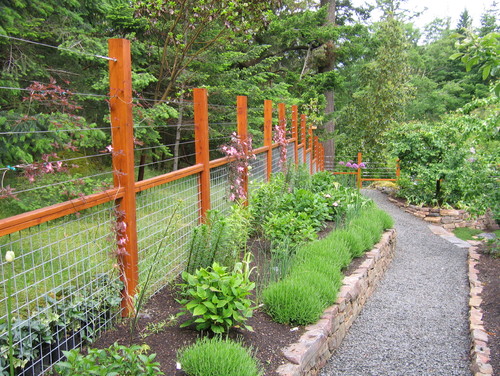
From the research I've done on deer fencing so far, there are two options that seem to work. You can either go tall—at least 7 feet and some places say 8 feet—or you can go wide. Two 4-foot-tall fences 5-feet apart are said to work because deer won't jump into an enclosed space and they can't jump high and long. The tall version is most certainly more economical because you can use sturdy plastic mesh fencing, although apparently it works best when you run a tension wire through the middle of it because otherwise deer will lean on it until it gives.

Masterfences.com photo
Short, double fences to keep out deer. Marthastewart.com photo
 A pair of shorter fences would certainly be more attractive, but the cost to build a nice looking fence could be astronomical. And I keep thinking about what you're supposed to do with the area between the two fences (I have visions of weeds taking over). If we lived on a truly large property, the double fence idea would be great. You could put up a pretty simple cattle-type fence, mow a path through the middle and call it a running track.

Our property is large enough that any fence is going to be a considerable expense but small enough that we're going to see the entire fence from the house. And I'm completely opposed to the idea of fencing only a portion of the property. To me, that's like giving away some of the land we own. We also have a creek to contend with (and I have no idea how you deal with fencing that). (You can see an illustration of our property here to get a better feel for the area).

Here is a good looking short fence with extending wires to get the height needed to keep deer out.


My initial thoughts on a deer fence are that we could do the short, double fence approach on the western edge of the property over by the vegetable gardens. It's a tight squeeze there because we also use that lawn by the road as overflow parking for guests and as a passing lane on our one-car-at-a-time road, but at least it would look nice and hopefully not be too offputting when driving by.

We might be able to turn the corners and extend that type of fencing situation a bit to the east on either side, simply for aesthetic purposes, and I'd do some kind of pretty design to the fence, at least the one closest to the road. The rest of it would have to be the tall mesh variety of fencing, although we could probably do shorter mesh by the cedar trees lining the driveway because the tall mesh would extend into the branches.

The driveway is a huge issue. We would never do any kind of manually opening gate  because it would never be closed. An electric gate sounds expensive, prone to breakage and ugly. The best solution would have been one that I should have thought of a few months ago, before we paved our driveway. Cattle crates (those metal bars that run across the ground) work on deer too, and so long as you put in a big enough area of them across the width of a driveway, they won't walk across them. But who wants to rip up 7 or 8 feet of brand new driveway for that?

Right now I'm looking for a local fencing company that specializes in deer fencing, but I've had no luck. There are lots of places that sell kits for the mesh-style fence, and that may be something we could do ourselves, but what I really need first is some hands-on advice and an accurate idea of what kind of money we might be talking about.

I still cringe at the thought of a fence around the yard, but then I dream of a garden that is intact and one that I don't have to spend hours each week trying to protect from the herd. I have tried to live at peace with these beautiful creatures but I don't think I can do it any longer.

I'd love to hear any suggestions, experiences or other information you might have about deer fences, fences in general or some magic bullet I'm missing in keeping the deer out of my yard.

Labels: , ,

18 February 2014

An unfortunate case of the munchies in my yard

The world outside my door appears to be frozen. Certainly nothing is growing, but I didn't expect things to be shrinking. Sadly, there are a lot of things shrinking in my yard.

The deer are starving. This winter has been so snowy and so cold with almost no relent (we're hoping for above-freezing temperatures this week which would be good for the soul and maybe, just maybe, decrease the size of the snow piles a little) that their food sources are buried or gone altogether.

Like most gardeners, I don't have a particularly good relationship with the deer, but I can't stand to see any animal suffer. What is concerning is that the size of the herds we are seeing are so much larger than in past years. Either the deer that usually hang out in the state park by our house are moving out in search of food or there are just a lot more deer. I fear it's the latter.

Not only are the deer getting even more bold (you would think the 275 pounds of dogs that live at my house would have some effect, but the deer practically laugh at them), they are eating whatever they can reach.

Unfortunately the main targets in our yard were the six arborvitaes we planted to screen the neighbor's house after we cleaned up a few dead trees in the woods. We bought Western arborvitae (Thuja plicata) Spring Grove in part because a neighbor planted several of them a few years ago and they grew quickly and were never bothered by deer even though they were planted along the road where the deer frequently stroll.

I've learned my lesson about "deer resistant" plants many times before, but I never even thought of protecting our trees for winter because they've never been touched by deer before. Usually, if the deer are going to make a meal out of something, they do it pretty early on in its time in our yard.


But now, all six of our Spring Grove arborvitaes have been "lollipopped." That is, the only foliage that remains is the top 18 inches or so. In my experience, the bottom never regrows, but the tree will probably live, but only grow foliage from the level it's at now and up. That isn't so good for when you're trying to block the view from your neighbor's kitchen window.

I'm not alone in this. The aforementioned neighbor with several Spring Groves that rapidly grew to about 20 feet tall suffered the same fate. The bottom 6 feet of his trees have been stripped.

The deer are munching on other things as well. Nothing within their reach is safe. The dwarf apple tree buried in a snow bank has ragged ends on every small branch, all nipped by deer. The same goes for the Limelight hydrangea in front (I'm not worried about this as it's destined for pruning anyway). The damage around the yard is extensive and is only likely to get worse.

That ragged end on the branch is a sure sign that a deer has been sampling.
By they way, I know so many people are buried under piles of snow so you probably don't need to see pictures of more snow. Too bad, you're getting some anyway.

These were taken Sunday, before another 6 inches fell Monday (and proceeded to blow into giant drifts). Testing paint samples on the front of the garage in fall sure looks like a great idea now, doesn't it? No one can say I haven't given the color a great deal of thought, though.


My poor meatball boxwood always gets crumpled in winter. It's hiding under there somewhere. 


Hard to believe this is what it looked like under that snow pile about 6 months ago, isn't it?


Have you noticed the wildlife in your area getting a big desperate with the crazy winter that so many of us are having this year?

Labels: , , ,

22 November 2013

A sweet treat, just not for me

Some gardeners are much better than I am about planting late-season crops. A friend on Facebook just posted a beautiful haul of beets the other day. I am just burned out by the end of the summer and I consider it a success if I can just stay on top of harvesting and general maintenance. Planting, and more importantly, nursing seedlings along in their early days is just not going to happen.

But I've been judiciously using my kale so that it would extend into late fall. Kale, like many of its cruciferous breathren, gets even better when the weather turns cool and it takes on a sweety, nutty flavor. In fact I've been planning a dinner in which my favorite kale salad is featured.

So imagine my surprise when I went out to the garden this morning and found my formerly lush kale bed looking like a stripped forest.


All that is left are the thick stalks, but every leafy bit has been nibbled off. The culprits are not difficult to finger. It is, of course, our healthy herd of neighborhood deer who apparently also know that kale peaks in cool weather.

I'm sure they enjoyed every sweet morsel of that kale. But I might have recommended a bit of parmesan and maybe a few toasted pine nuts to go with it.

Labels: , ,

03 June 2013

It's starting to come together

I think there are few things better than an insanely productive spring weekend. As I mentioned on Friday, this was a weekend for me to just kick it in the garden. And kick it I did.

I got up and out there early both days and just kept pushing it. I got the largest garden (the "original" one off the patio) weeded and top-dressed with compost, did a bit of edging, planted oodles of plants and patched about a billion holes in our pathetic lawn.

I'm happy with how the terraced garden off the deck is coming in its "leap" year. The fringe tree in the center is just starting to show leaf buds so it's a bit sad looking right now. I'm very happy with how the Orangeola Japanese maple on the left is doing. I think it must be 7 or 8 years old now.


The "meatball" boxwood in the corner of the garden has really grown but I'm waiting for several more weeks before I prune it back into shape so that all the new growth has a chance to flush out. It half swallowed a large rock we had there so we levered the rock over a bit and added another smaller stone we had kicking around the garden. I also put in a few plants for a mini rock garden. Although this over-exposed picture was taken Sunday evening and is a bit glary, I'm really happy with how that corner looks. Sometimes I think it's best to break garden beds into their own areas and plant "mini-rooms." 


I love this new basil I planted by the tomatoes. It's called 'Crimson King' and it looks just like a regular sweet basil but it has this great color, which is supposed to stay throughout rather than turning green like some purple basils. Do you see all that powder on the leaves? That is all some of the crazy amounts of tree pollen that have been blowing all over the place for the last week. Our deck is actually yellow most mornings with pollen.


I also whipped up some homemade deer repellent, which is on the patio cooking in the sun to get extra funky. The funkier the better when it comes to repelling deer and bunnies.


And after all that hard work in the garden, I snapped this photo of maybe my most favorite part of our property: The American beech trees. No matter how much we do, Mother Nature always seems to do it better, doesn't she?

American beech

Labels: , ,

17 July 2012

Don't try to understand the deer (and how to keep them from eating your garden)

Deer are odd creatures. They don't seem to have any rhyme or reason to what they feel like eating on any given day. They stand in front of cars and stare at the passengers. They will stand in a yard just feet away from a house with a pair of dogs going absolutely berserk barking at them without looking like they have a care in the world.

I guess it's time I finally give up on trying to predict what our neighborhood deer are going to do next. The other day I caught one staring at me reading the newspaper on the deck from the ferns. It casually turned and disappeared, sort of like the baseball players in "Field of Dreams." I suspect that's how they view my garden: I built it and they have come.

For years, the first plants they would hit in the garden were the hydrangeas and the lilies. Then they'd come nip the occasional petunia in a pot in the garden or sample a rose. And because I am obviously a slow learner, I usually never did anything about preventing them until they'd already started sampling. The same bad habit holds for this year, but for some reason I thought they were going to skip my house this year. Do not ask what sort delusional thinking allowed me to entertain that idea for even a nanosecond but suffice to say, I was wrong.

The hydrangeas look fine. Even the Annabelle hydrangea, which apparently has proven to be very tasty in the past, remains untouched. I have lilies blooming that I have surprised me with their color; I've never seen them bloom before because the deer always nipped off their buds. Nope, this year, the deer went straight for the hosts. For whatever reason, they've never done a lot of hosta sampling in my yard before, even though I know many other gardeners have experienced the sinking feeling of looking around the garden and finding only stems standing where just a day before were gorgeous bold leaves.


I could show you dozens more pictures just like this, but you get the idea. In the case of poor 'Fat Cat,' they actually ripped it right out of the ground (I recently planted it). Any not-fully grown hosta (which is most of them) has been reduced to stems. They didn't care what color they were or where they were growing, they just mowed them down.

Ultimately, it's my own fault. After 10 years of living a quarter-mile from a state park with a very healthy deer population (I wish they would just stay in the park), I ought to know that the deer are going to eat SOMETHING in my garden. It might not be the lilies or the hydrangeas or the petunias, but it will be something.

In case you're wondering how I fend them off, at least when I'm smart enough to do it, I've tried just about everything you can imagine to keep them away and everything seems to work for a little while. But the least expensive option seems to work the best, so long as I'm thorough about using it and reapply it after a good rain (not a problem this year). This core of this recipe was given to me by my mother who got it from someone else, but I've added a few extras to it that I think help (and they certainly don't hurt).

Homemade deer repellent

4 eggs
1 tablespoon of cayenne pepper
1 teaspoon black pepper
A couple drops of dishwashing detergent (to help it stick to leaves)
Whole garlic cloves, crushed or smashed (I probably throw 6 in but just put in whatever you have)

Put all the ingredients in a rinsed out gallon milk jug and fill the rest with water. Shake thoroughly. Then set it out in the sun for a few days. You want it to get good and nasty. After it has "fermented" a bit, dilute it about 4:1 and sprinkle it all over everything. I think it's especially helpful to make a "perimeter" around the garden as well as being sure to thoroughly coat any prized or particularly tasty plants. It can create some discoloration on leaves, particularly on blue hostas, but discolored leaves are better than no leaves, right? 

Labels: , ,