I'm very excited to share a little Q&A session with talented garden designer Jack Barnwell. I found out who Jack was
last summer after spending years admiring one of his designs without knowing who was behind it. I make it a point to visit the garden at the Hotel Iroquois on the island every year and it continues to be one of my favorites. His designs—lush, colorful, well-structured creations—are impressive in and of themselves, but imagine trying to create these kinds of spaces without any kind of vehicle involved once it got to you.
Picture yourself having to create a new garden by towing everything to the site by bicycle. That's what Barnwell is faced with every day. His company Barnwell Landscape and Garden Services is based on Mackinac Island, Michigan, where motorized vehicles of any kind are outlawed. So everything moves by foot or by bike. How'd you like to move soil that way?
Here's a little more information about Barnwell:
 |
| Jack Barnwell taking plants to a garden. Jack Barnwell photo |
Jack Barnwell is the owner of Barnwell Landscape and Garden Services on Mackinac Island, Michigan, which designs, installs and maintains Mackinac Island’s most outstanding resort and residential properties. Jack has been designing and planting the gardens at the luxurious Hotel Iroquois for 10 years and expanded his business to include many other hotels and homes three years ago. His plantings won Best of Show at the Cincinnati Flower Show and have been featured in many publications including Horticulture Magazine, Lawn and Garden Retailer and Landscape Management magazine. Barnwell Landscape and Garden Services plants thousands of flats of annual flowers every spring to give Mackinac Island its renowned splash of color. They specialize in innovative annual installations including incredible hanging baskets, pots, and window boxes, but also do complete landscape contracting, hardscape and heirloom quality perennial gardens.
Q&A
The Impatient Gardener: What are some of the gardening and design challenges unique to working on Mackinac Island?
Jack Barnwell: The most obvious challenge to landscaping and gardening on Mackinac Island is the fact that we are a motor vehicle-free resort community. We do not even have golf carts or similar electric utility carts that many other resort like communities have. We use horses, bikes, and old-fashioned ingenuity to overcome the challenges we face. It is important to understand and respect the fact that adhering to this code of law is in many ways what has made Mackinac such a unique destination. That, combined with geological wonders, grand Victorian architecture, and of course, stunning gardens, has created an experience that attracts hundreds of thousands of tourists each summer.
Logistically, running a fast paced gardening company on an island without vehicles certainly gets my head spinning at times. All of our materials have to be shipped up, usually from growers and distributors 4-7 hours away. Then they cross the Mackinac Bridge and are unloaded onto freight barges. The barges are then unloaded when they reach the island onto horse drays (flatbed wagons with a two horse team), or our fleet of bike carts. Once the materials arrive to the job site, they are unloaded by hand and installed ... by hand. There are many people that I rely on to make all of this happen day after day, from delivery drivers, boat crews, dray horse crews, to my courageous crew, we are all working together to blanket Mackinac in color each Spring. During the spring annual flower planting season, my crew and I plant 10,000 flats of flowers, hang hundreds of hanging baskets, and transform the island in just a few weeks. All by horse and bike.
 |
| When Jack Barnwell talks about a boatload of plants, he's speaking literally. Here's a shipment of trees on its way to Mackinac Island for fall planting. Jack Barnwell photo |
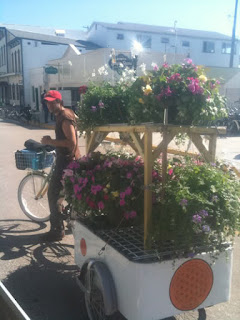 |
| Loaded up and using bicycle power, one of two main modes of transportation on Mackinac Island. Jack Barnwell photo |
TIG: The gardens at the Hotel Iroquois rely heavily on hardscaping and stonework, without them becoming an overwhelming element. How important do you feel that kind of structure is to a garden?
JB: The gardens at the Hotel Iroquois do have a lot of hardscaping involved because it is important when designing a garden to have in mind traffic patterns and usage. The hotel has a very popular restaurant that receives many patrons every day, and the gardens themselves draw quite a crowd so it is important to allow for space and comfortable access so that people do not feel crowded or overwhelmed when visiting the restaurant, lounging around the hotel, or simply enjoying the gardens.
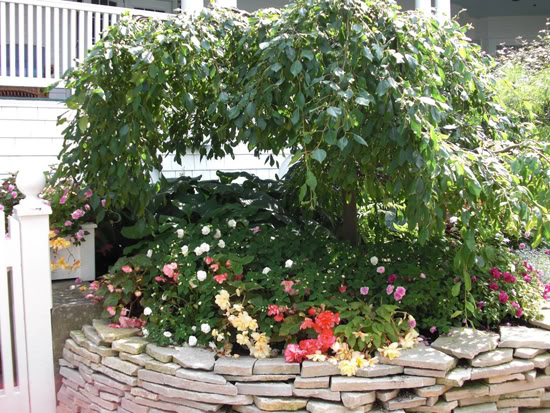
In the gardens themselves, I like to incorporate small rock walls and boulders for several reasons. First, adding that mineral element gives good balance to a garden, it also creates structure and changes in height within a garden. Stones, especially dry stacked in a wall add an element of timeless beauty to a garden, they create intimate pockets and add a verticle surface that can be climbed up or trailed down with different plants that otherwise would not be utilized in a simple sloped garden.
 |
| A dry stacked wall raises the bed to bring a weeping shrub to eye level in Barnwell's Hotel Iroquois garden. The Impatient Gardner photo |
TIG: How do you keep designs, be they large-scale gardens or containers, fresh and exciting from year to year?
JB: I keep designs fresh by keeping up on new and exciting varieties. There are so many new plants coming out with wild colors, textures and smells, especially in the annual flower world. It is fun to experiment with those every year. I also keep designs interesting by sharply focusing on developing my sense of place. Gardens on Mackinac Island are unique in that they are on Mackinac Island, but there are many sub-realms to consider when designing here too. The property, and where it is located, where it will be viewed from, usage, the interior design of the home or hotel, and the feeling the garden is intended to present are all very important factors to consider and make every landscape unique with its own signature.
TIG: Do you have a favorite garden that you've designed?
JB: I have designed many gardens on Mackinac Island, as well as many other locations around the country. It would be so hard to say I have a favorite, as they all have their own personalities. There is one garden on the island that comes to mind though. A couple years ago, we did a Japanese-inspired peaceful garden that is quite a sight to behold. There are mossy paths, beautiful boulders and bluestone walls and tea table areas. We planted a 70-year-old Japanese Maple in there that had to be shipped over on a custom trailer built just for that tree so that it could be moved into position without disturbing the tree or the established lawn. In that garden, spring is welcomed by hundreds of delicate bulbs planted under the architectural branching of the different Japanese maples, drifts of Trilliums give it that classic Northern Michigan look, and bouquets of pure white daffodils dotted with a surounding of blue anemone pop up through ground cover areas of Pachysandra and Myrtle. I have a certain affection for that garden, but I still couldn't say it is my favorite. Gardens are constantly evolving, changing, and hopefully improving. My next favorite garden is reborn everyday.
TIG: You mix a lot of annuals in with perennials, shrubs and bulbs in your design, creating a truly mixed garden. With so much going on, how do you keep it from being too much?
JB: I usually design gardens with a very diverse mix of annuals, perennials, shrubs and bulbs because they all have their place spacially as well as within the contraints of bloom time. For example, I love the origami like blooms of a white siberian iris, but as they fade, their foliage can still be appreciated for the mass of spikes left over once the flowers are cut back. Better yet though, why not use a couple of those spikey pillows to hold up the stems of ornamental lillies, with some vista supertunias climbing around and through the spikey fronds still holding strong from that mid-spring bloom of the siberian iris, then at their foot, and under the supertunia structure, try bacopa, allysum, or dichondra as a groundcover.
This is how my mind works as I look at designing, that is why many of my gardens are so diverse and constantly changing through the seasons.
 |
| At the water's edge, roses mingle with annuals and herbs. The Impatient Gardener photo |
TIG: What are some of your favorite plants right now?
JB: My favorite plants right now... hmmm... that is a tough one. I am constantly amazed at the innovative stuff coming out of
Proven Winners. They have incredible annuals that thrive, but their Colorchoice Flowering Shrubs are outstanding as well.
 |
| Barnwell uses many Proven Winners plants in the Hotel Iroquois garden including Papyrus 'King Tut', multiple varieties of Supertunias, Argyranthemum frutescens 'Butterfly' and more. The Impatient Gardener photo |
TIG: Is there a plant of any kind that you feel a garden just isn't complete without?
JB: In zones 4-6 which I work in most often, I would say there is no garden complete without some kind of hydrangea. They are such a classic that can be used as a great cut flower, dried, or appreciated as big lush foundation plantings and hedges even.
TIG: What sort of combinations are working on for the containers in downtown Mackinac Island this year?
JB: The containers downtown Mackinac that will hang from the light posts will be all Proven Winners annuals again this year. Most of them are Supertunia based, with three or four other varieties in there including a grass on some kind in the center. I like using spikey grasses like blue mohawk because things can climb up the sturdy reeds. I am excited about the combinations I have designed for this year and can't wait to see them when they all arrive on the dock. That day, when the city baskets arrive, we have 350 hanging baskets all arriving at once this year. Wahoo...
The combination I am most excited about though has climbing black-eyed Susan vine in it. It will trail down throughout the combination as well as climb up the hanger and onto the lamp post!
 |
Some of Barnwell's container designs hanging on Main Street in Mackinac Island. The Impatient Gardener photo
|
 |
| Containers with grass in the middle or a vine that will go up the hanger and trail down will feature into Barnwell's designs this year as well. Jack Barnwell photo |
SaveSaveSaveSave