The Impatient Gardener

20 January 2017

FRIDAY FINDS

It feels like it has been a long time since there's been a Friday Finds post here. I can't even tell you how busy this month has been and amazingly I feel like I'm already behind on gardening. There are seeds and dahlia tubers to be ordered and I've not done anything about formulating a plan yet!

But there will be time for that soon (and if not, I'll make time). For now, let's check out some of the goodies the Internet has been dishing up lately.

Margaret Roach's podcast of Q&As with Ken Druse is great. I love the question about decyphering degrees of shade. I wonder if in our quest to simplify plant labels we haven't gone too far.

http://www.flowerpatchfarmhouse.com/ten-rose-care-myths-debunked/
Flower Patch Farmhouse photo
I mentioned that I haven't ordered seeds yet but back in fall I ordered eight David Austin roses. Eight.  You may recall it was just a few years ago that I swore off roses. I'm a sucker. But there's an excellent rose care article over at Flower Patch Farmhouse that I'll be hanging on to.

One of the things I'm hoping to do in 2017 is increase the number of garden conferences and events I attend. Here's a great roundup of several excellent ones to consider.
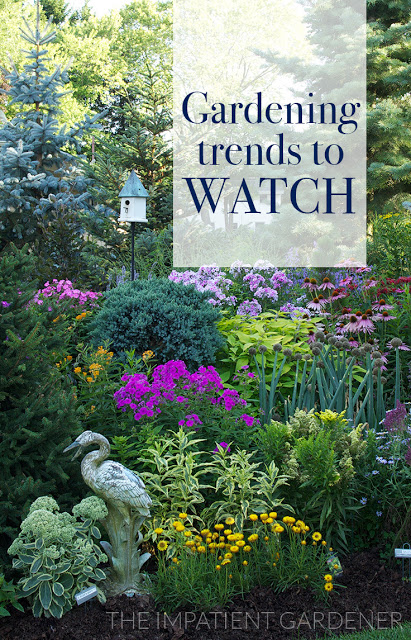
http://www.theimpatientgardener.com/2017/01/garden-trends-for-2017.html

Did you catch my predictions for gardening trends for the coming year? Tell it to me straight: Do you think I'm on the right track?

And lastly, I just wanted to take a moment to toot my own horn a tad. I was thrilled to find out last week that I was named to two great blog lists.


I was named to Lawnstarter's Top 50 Garden Bloggers list (aka the Golden Trowel awards).


And I was also named to Toolversed's Top 10 Gardening Bloggers list.

In both cases I'm delighted to be in the company of some of my favorite bloggers. Check out their blogs at the links above.

There's lots on the agenda for this weekend. More work on the basement, a Green Bay Packers game, maybe some quality time with plant catalogs and a bit of birthday celebrating (such as it is when you get to be my age). What are you plans?

Labels: , , ,

11 August 2016

AN UNWELCOME VISITOR

For years I've read horror story about Japanese beetles invading gardens. I'd even talked to local gardeners who have been plagued by the irridescent buggers. But until this year I'd never even laid eyes on one.

I read an article that suggested that our springs are too cold here (and particularly at my house near Lake Michigan) for them to get comfortable and take up residence and that seems like a logical explanation. Given the warm spring and very mild winter we had and the fact that I'm seeing them now for the first time also supports this theory.

This little bugger was just one of the little guys hiding in the blooms of my containerized rose. On the right you can see some of the damage they caused in the flower.

I first noticed them a couple weeks ago when I returned from being gone for 10 days. I was admiring the new blooms in my potted rose (developing because I was diligent about deadheading before I left), and noticed something black in the middle. When I pulled it out, there was no doubt: This was the dreaded Japanese beetle I'd heard so much about. I promptly crushed it and then found two more in other flowers that met similar fates.

I've only found them in flowers so far but I'll bet my total number of kills is up to 15 or so. And I'm not naive enough to think I've found all there are to find.

So far I've only found them in that particular rose, but I'm keeping an eye out for them elsewhere. They made a real mess of the flowers, chewing big holes in them, and I'm certain they are doing other damage that I've yet to discover. I've not noticed any leaf damage yet.

I'm concerned because some of their other favorite plants to munch on are viburnums, which I have at least a dozen of, zinnias and apples. I've checked the apple tree but I need to give the rest of the plants a close inspection.

I've also started doing some research on them, and it's not hard to find. Here's one good paper with some information from which I've just learned that squishing them is a bad idea because they release a pheromone that attracts others of their ilk. Turns out I should be drowning the little buggers in soapy water.

I'm not sure if Japanese beetles will be an ongoing problem after this year at my house. If we get a typical Wisconsin winter and spring, that may solve the problem (and cause others including making the gardener crabby), at least temporarily. Still, I'd have been plenty happy to remain one of the few who was blissfully unaware of this invader.


Labels: , ,

13 April 2015

A WEEKEND IN THE GARDEN: IT'LL CURE WHAT AILS YOU


After one of the more challenging weeks of my working career, I was absolutely spent going into the weekend. I desperately needed to just stop thinking about everything for awhile.

Thank goodness Mother Nature cooperated and presented two nearly perfect spring days for me to get lost in the garden. And that's exactly what I did, getting caught up on some cleanup and a few small garden projects.

chive hedge
Right now they are just little clumps of chives around the perimeter of the circle garden, but soon they'll form a mini hedge.

The best thing I did in the garden was continue to work on the chive hedge in the circle garden. I started this as an experiment a couple years ago on just one section of the garden but was so thrilled with it, I've been slowly working toward extending it around the entire garden, including the interior borders. The lovely thing about chives is that they are so easy to grow and divide. The entire hedge has come from dividing the chives I had and dividing a few from my mother's garden. Because they grow quickly, I can sometimes divide them again at the end of the season.

I've made it almost all the way around the perimeter, and the one section is completed on the interior as well. I'm growing a few from seed as well and as soon as those plants are hardened off, I should only have a small amount left to do.

I love the hedge for a variety of reasons. For one, I think it lends structure to this garden that has always suffered a little bit from an identity crisis. I think that's a factor of having too many gardens; I spread my efforts across too many spaces so it can take a long time for one to be just right. But it also has the benefit of keeping out rabbits. I don't fool myself into thinking that the deer will give a rip about chives, but I think bunnies will. And lastly, they are so beautiful when they are in bloom and they are a huge draw to pollinators. Plus, why not have a hedge you can eat.

Unfortunately, in my much-needed Zen state of gardening, I failed to pause and take photos. If I had you might have seen an interesting development in the skinny patio garden. Things don't grow there like they should. The results of a soil test shed some light on that, but I've always felt like the inability of the climbing rose to thrive there was indicative of a larger problem. Turns out it probably was just the rose.

Since I'm completely redoing that bed—digging out everything and moving it or tossing it and replacing the soil—I dug up the climbing rose in order to move it. What I found was roots, in the perfect shape of gallon container, trapped in a circle. Although I purchased it in a two- or three-gallon container, clearly it had been grown in a gallon nursery pot for too long, then transplanted in a larger pot for sale, but remained rootbound. I'm irritated about it and frankly I'll be a little more careful about where I buy roses from now on. I trimmed up the roots to get rid of some of those that were strangling everything and moved it over by the veggie garden. Honestly, I don't give it a great chance of thriving there, but I'll continue to nurse it along.

Virginia bluebells
While cleaning out the beds I unearthed the tiny purple tips of the Virginia bluebells popping up.

So many leaves fell last last fall that the gardens were really messy. I ended up just using the leaf blower (I detest leaf blowers because I find them obnoxious but I recognize that they have their place and I'm pretty sure this is it) to clean out the beds. Unfortunately I also blew away just about every plastic plant tag, so I made a mental note about being better to use my metal plant labels.

Of course there were little projects along the way as well. I divided a few perennials, pruned some clematis and swung by my mom's garden to give her some help digging all the plants out of a garden where a new deck will be situated.

In a couple months a weekend of this kind of hard-labor gardening (as opposed to plant shopping and planting) will seem dreary and monotonous, but for now it was glorious respite from the more serious bits of life. My hamstrings are sore and my fingernails are gross but I wouldn't have it any other way.


Labels: , , ,

21 January 2015

HOW TO RESEARCH PLANTS

One of the great things about this time of year, when northern gardeners have no choice but to dream rather than do, is that it affords the great luxury of spending a great deal of time on research.

I used to just go to the garden center and buy whatever struck my fancy that day. Sending a gardener to a nursery on the first warm day of spring is like sending someone on a starvation diet to the grocery store. It's not going to end well.


But in recent years I have gotten so much better about researching plants before I buy them. This is particularly true with more expensive plants and that only makes sense. A few years ago I made the mistake of coming up with a long list of well researched plants and then spending weeks trying to find them at a local nursery. Fortunately, at least two of the nurseries I like now publish lists of most of their stock, so I can narrow down cultivars depending on what I can pick up locally.

For smaller plants I can order online and I have had great success with most of the plants I've purchased this way.

About three-quarters of the Fine Gardening magazines I've saved going back to 2008. I started going through them on Sunday when the stress of the Green Bay Packers game was more than I could handle. They are a great source of information and inspiration. 

As I research via the Internet, books and my foot-tall collection of old Fine Gardening magazines, I make a list on my phone so I always have it with me. You never know when you're going to be at a nursery that might have what you're looking for.

How I go about researching a plant depends a bit on where I plan to buy it. If I'll be buying it locally, I try to start with nursery-provided plant lists. Some nurseries don't have their 2015 lists available yet, but if their lists from last year are still on their website that's at least a good starting place.

If I'm buying online, I start with a nursery I trust either through experience or reputation. I often refer to the Garden Watchdog on Dave's Garden to find or check up on a nursery.

After I find a plant I'm interested in, I start with a Google image search. It is amazing how different a plant can look in different circumstances. Nurseries often over-saturate the color in photos to make blooms look more vibrant or the color may be different depending on how much sun it's in. I try to pay special attention to photos by home gardeners or bloggers because I feel like this is a more accurate depiction of how a plant might look in my garden.

If I'm still interested in how the plant looks after I've seen more photos of it, I seek out more information on it. You would be surprised at how different exposure needs, size and blooming information can vary for the same plant. I'm wary of information from breeders because they will only provide the information that casts the plant in the best light. Good nurseries are better about providing less flattering information about a plant because it is in their best interest that you do well with plants you buy from them. Bad nurseries (and big box stores, in my opinion) don't care if the plant lives or dies, they just want you to buy it from them. And some of the most practical information comes from home gardeners and landscape designers (who also have a vested interest in the long-term success of plants).

Here's a comparison of different takes on a beautiful English rose 'Abraham Darby.'

I don't think anyone is going to argue that 'Abraham Darby' isn't a gorgeous rose (and I know plenty of people who adore that rose). But reading reports from actual gardeners (in the last column), offer some pretty interesting tidbits. Several people reported having serious issues with blackspot even when other roses in their gardens were unaffected, even though the nursery says it has "superb" disease resistance.

Other home gardeners reported frustration with its heaving nodding blooms on weaker stems, and there is absolutely no mention of that from either the breeder or the nursery. As a zone 5 gardener, the first thing I look for in a plant is hardiness and while many sources claim 'Abraham Darby' is hardy to zone 4 or 5, the report from at least one gardener that it is not CANE hardy in zone 6 is cause for major concern. There is a difference between plant hardiness (meaning the plant won't die in winter) vs. cane hardiness (meaning the canes won't die back in winter. If a rose isn't cane hardy it will have to regrow every year, meaning that it will not be nearly as big as it otherwise would be. It also means that it's not suitable as a climber.

Of course reports from home gardeners on the Internet have to be taken with a grain of salt. There's really no way to know if that person knows how to grow anything, or what the conditions are like in their yard or if they remembered to water it.

But if you can find a local gardener who you trust and you are confident knows their stuff, then that's as close as one can get to the real facts. I've been searching for a new climbing rose for the front of the house (yes, I swore off roses—again—last year, but I lied—again) and after scouring the Internet and even asking readers and friends, I was pretty confused.  I ended up having a wonderful email exchange with a fellow local master gardener who is a true rosarian. He came up with a great suggestion: 'Autumn Sunset.' We're going to get together this week to talk more about it, so that could still change, but I'm certain I'll get better information from him—someone who grows roses in my area—than most places I could look.

I'm not suggesting that hours of research has to go into every plant purchase you make. One of life's true joys is going to a nursery and just picking up something because it interested you. But that's something I only do with plants of a certain cost and ease of care. If I have to spend a lot of money or time babying a plant, I want to make sure that I choose the correct one from the beginning. Too many gardeners get discouraged because they can't grow X-plant (fill in your favorite plant failure there), when it's quite possible they may not have chosen the correct cultivar in the first place.

Take advantage of these long and torturous gardening-free days to do the research you won't have time for once spring has come and you'd rather be in the garden.


Labels: , ,

15 September 2014

OFFICIALLY ON NOTICE

This is the time of year when I start taking stock of garden with a long-term view. In general terms, it's easy to spot areas that need attention and improvement. In some cases, though, it's identifying plants that I need to take a hard look at.

And I am officially putting two pretty important plants on notice. It's time to shape up or get shipped out.

The first, I'm very sad to say, is the fringe tree (Chionanthus virginicus) in the little terraced garden off the deck. (See a schematic view of what gardens are where here.) I planted it as the centerpiece of that garden in 2011, so this should have been its "leap" year (plants are said to "sleep" the first year, "creep" the second year and "leap" the third year), but it has done anything but come into its own. It's trunk is still quite skinny, showing very little growth since we planted it. It has gained some height and width but it's very odd how the leaves are sort of clustered at the ends of the branches. I've counteracted that problem by allowing a clematis to grow up it, which helps quite a bit, but it still looks sparse to me.

I fell in love with the idea of a fringe tree because my mom has a beautiful one that is gorgeous and dense and absolutely laden with flowers. Of course hers is much older than mine but neither of us remembers hers ever being so sparse. And worse yet, the flower situation was horrible this year.  I think there were maybe two flowers on it. There is a chance I may have a female plants while my mom has a male plant as the flowers are showier on a male. Female plants will eventually produce fruit as well, but I've seen no sign of that.


I do like the large leaves of the fringe tree and its bright yellow fall foliage, but given that it is one of the last trees to leaf out in spring and the flowers have been disappointing, the cons are currently outweighing the pros.

Given that trees are expensive and slow growing, I'm inclined to just hang in there with the fringe tree for one more year, but if the perfect replacement tree pops up, you never know, the fringe tree may have to go. In either case, it's definitely put up or shut up time for the fringe tree.

The second plant that I'm putting on notice that it might be on its way out, is there through no fault of its own. I'm speaking of the 'Cancan' climbing rose on the front of the house. Despite a beautiful display of flowers in late spring or early summer (and a few repeat blooms right now), every year this plant is absolutely eaten alive. In previous years aphids have been the problem. Earlier this year I found a sawfly larvae infestation on it. I thought I had it handled, but the leaves are now skeletons. Its shabby foliage looks absolutely horrid.


I don't think there's anything wrong with this climber. And in many ways, it's a good location for a rose: southern exposure, next to the house, nice and warm in the winter, etc. But this garden is a tiny strip of soil maybe 3 feet wide between the house and the patio. Rain doesn't reach it much and I don't really know how deep the soil there is.

I was better about watering there this year than I have been in the past and I really was babying the rose. It's my belief that insects are opportunistic and usually prey upon plants that are compromised in some way.

This year, when the nearby window box was full of orange flowers, I realized that the bright magenta blooms of 'Cancan' don't look so great with a lot of color combinations I tend to plan in the window box.

So I'm starting to think that maybe I need to look for another climber for that location. I'd love for it to be a rose, but that may be a fool's errand given Cancan's fate. Whatever goes there, I think I need to do a thorough job of amending that soil heavily and see if that helps plants stay healthy.

I wish plants read blogs. Maybe these two would shape up if they knew that I'm deciding their fate.


Labels: ,

11 August 2014

A ROSE IS A ROSE (EXCEPT WHEN IT'S DEAD)

Can anyone explain to what it is about roses that makes gardeners go nutty? OK, maybe some of you may have been able to resist the siren song of this queen of all flowers, but I have not, despite the fact that they torment me.

I kill roses. I can think  of at least five that have met their fate at my trowel, and yet within month of swearing off "fancy roses" yet again, I have thrown my gardening heart into one again.

Sidenote: If you ever hear me swear off something gardening related, be it a particular plant or a broader concept like not adding any more gardens, you would be wise to bet me that I don't really mean it. Because sooner or later I always do it/plant it again.


But back to roses. I have been able to grow Oso Easy roses extremely well. I almost don't even consider them to be roses because they seem to require less maintenance than almost any perennial in my yard. I also have a couple of climbing roses—a William Baffin and CanCan—that have bucked the trend. The problem with all those roses is that they have little to no scent. And really, what's a rose without a scent? Just another pretty flower.

I don't know why I care roses. There are plenty other flowers that many gardeners wouldn't be without that I live without just fine. I think it's because roses seem to be the pinnacle of gardening success. Their reputation (deserved or not is debatable) as fussy divas somehow makes them something to be conquered.

This spring my 'Carefree Beauty' rose was dead, one of the few victims of a winter I thought would wreak havoc on much more of the garden than it did. I bought it because it was supposed to live up to its name and it joined a growing list of "Roses I have killed."

That's when I swore off non-landscape-type roses.

And yet just last week I received a package in the mail with a rose in it. Buying a rose in August is probably not the smartest move. Buying a rose in August via mail order really isn't. But I did it anyway.


This one, a compact white floribunda, will live in a container and I'm hoping that will give me the edge I need to keep it alive. I plan to coddle it on the patio this summer, overwinter it in the unheated garage and hopefully be able to place it in the garden next year. I've been inspired by other gardens to include more containers right in the garden for interest and plants with special needs, which clearly roses are (for me anyway).

I'm not placing bets on if this rose's fate will be different from its predecessors, but gosh let's hope so. If only so I can get it out of my system once and for all. Maybe.

Do you have a way with roses? Or are they just not something you're all that interested in?

Labels: ,

25 June 2014

HOMICIDE IN THE GARDEN

Creepy crawlies are as much as part of gardening as soil and sun. Gardeners tend to have different views on such things, some taking as much interest in the bugs as the flowers and heralding the sight of a helpful critter as much as prize-winning tomato. Others abhor the little buggers.

I remember reading a gardening forum post once in which the poster was petrified of worms. The poor woman was lambasted in the follow-up comments and I felt horrible for her. I happen to be quite proud of my worms, but I can understand how someone might not be fond of them. So I try to take an open-minded view of gardeners' reactions to the creatures that share our yards.

As I mentioned, I love my worms. I actually count them when I dig a hole. When I removed all the sod for the new garden area it took me longer because I picked out all the worms out of the sod and put them back in the garden. I also love seeing bees, butterflies, moths and birds in my garden. And I always talk to the toads when they show up.

But really, that's about where it ends for me. I find everything else to be pretty disgusting. Snakes are a complete deal-breaker for me. To my knowledge, we have no poisonous snakes in Wisconsin, but it really doesn't matter. The garter snakes that tend to show up in gardens might as well be rattlesnakes or boa constrictors as far as I'm concerned. My reaction to them is no different than if they were planning to turn me into dinner: I scream (like horror movie kind of scream) and run faster than I ever have before. And then about three weeks later I realize I will have to go back into the garden at some point. I dislike snakes so much that if someone posts a picture of one on Facebook, I immediately hide the post.

But I don't most bugs either. That presents a problem because in most cases, the best way to deal with bugs in the garden is to physically remove them from a plant. And that involves a lot of bug touching, usually followed by bug homicide.

I'm OK with the latter. Maybe it makes me an awful person, but killing a bug that is not beneficial to my garden is not a problem for me. I'm not sure at what size I draw the line on critter homicide, but I think it's safe to say I couldn't kill anything with fur or anything bigger than, say, the end of my thumb. I offer as proof the fact that the other day there was a baby bunny in front of my car as I turned down the driveway. I suspect this bunny (or his brothers, sisters, mother, father or cousins) is responsible for mowing down my Sweet Summer Love clematis and a few other things, and for one brief second, as that little brown puffball looked me in the eyes, I realized I could prevent a lot of future garden damage with one tap of the gas pedal. But of course I couldn't bring myself to do that. Just as I cannot bring myself to do anything but set up a relocation program for the red squirrels eating our garage (literally).

All of this brings me to my point: Sometimes, as a gardener, you have to kill a bug or two, even if you really don't want to.


The climbing rose 'CanCan' that I have on the front of the house has performed so well for me, but the past two years it has had horrible aphid infestations. My goal for this year has bend to keep it healthy enough to ward off the little buggers (I have a theory that healthier plants will not attract bugs the way stressed plants will). I've been patting myself on the back that despite a lot of lush new growth, so far CanCan has not gotten any aphids. But then I noticed some leaves were looking a bit lacelike. Something was eating them.
My climbing rose looks pretty good from a distance, but get a little closer and you'll see the damage.
Damage caused by sawfly larvae.


When I turned over the leaves I found a tiny green caterpillar looking bug. It didn't take long for the Internet to show me that it was sawfly larvae. The solution: get rid of them as quickly as possible.

Sawfly larva on the backside of a rose leaf.

I don't know if I have a "soft" nozzle on my hose, but blasting bugs off with water has never worked for me. Then I tried insecticidal soap, but the next day the larvae were still there and growing. There was only one icky way to get rid of them: Squish 'em.

So I put on my gloves (this is the main reason I wear gloves when I garden, by the way, in case I come in contact with a creepy crawly), sucked it up, and started scraping the little buggers off those leaves. They are so small and soft that that action alone ended their time in my garden.

It was gross and hated it, but a gardener's got to do what a gardener's got to do. Unless it involves snakes. Then all bets are off.


Labels: , ,

10 July 2013

The Garden Appreciation Society -- Week 9 -- Link up!

This week's Garden Appreciation Society bouquet is a first for me on two counts. For one, it is the first time I've ever had enough roses to make a bouquet from my own garden. And secondly, it is the first time I've endured serious pain to make a bouquet. Holy smokes these roses are thorny!


These Oso Easy roses (I think they are 'Peachy Cream') would be perfect in a wild mixed bouquet, although it would have to be a short one because they do no have long stems. Unfortunately, I'm on my way out the door for a bit of a sailing jaunt and I didn't have time to do more than cut a few, bleed profusely and jam them in a vase.

The Impatient Gardener -- The Garden Appreciation Society -- Oso Easy Peachy Cream roses

The Impatient Gardener -- The Garden Appreciation Society -- Oso Easy Peachy Cream roses

The Impatient Gardener -- The Garden Appreciation Society -- Oso Easy Peachy Cream roses

As I mentioned yesterday in the garden tour, these roses don't have a lot of fragrance but what fragrance they do have really comes through inside. One more reason to appreciate your garden in a new way!

You guys continue to blow me away with what you are cutting out of your gardens. Thank you so much for sharing your creations.

Don't forget to link up this week and please don't miss the stunning bouquets from last week's Garden Appreciation Society.

And don't miss out on past weeks.

Labels: ,