The Impatient Gardener

25 January 2017

MY SWEET PEA ORDER

Dear me. It's still a good four months before I have a hope of planting anything, but I'm very much behind on making a plan for what I will grow from seed this year. I need to start by going through what I already have and that will require riffling through boxes and Ziploc  bags and generally realizing that my "organizational system" is lacking.

There's still some question about what vegetables and flowers I'll grow this year, but there is no doubt that I'll be growing sweet peas, so earlier this week I at least finished up with that order.

A bouquet of sweet pea blooms from my 2015 garden. The scent was absolutely heavenly.

Of course I ordered too many. How can a gardener possibly choose? Plus, I enjoy giving spares away to good homes. A sweet pea charity if you will. The past two years I've bought a mix of heirlooms and spencer varieties to make sure that I had the scent from the heirlooms but the more showy flowers of the spencers. This year I bought mostly spencers but focused on varieties said to have good scent. There is no point whatsoever to growing a sweet pea if it doesn't smell like a sweet pea, in my mind.

Here's this year order.

I ordered the majority of them from Owl's Acre Seed, a British company whose seed I had great success with two years ago. Whether it was just a better year for them than last year, or the seed really is better I can't say but I'm hedging my bets and going back to what worked better for me. Plus, they have a better selection than a lot of seed providers in the U.S.

Noel Sutton

Owl's Acre Seed photo

I have a weakness for sweet peas in general but show me anything in the blue family and I go all weak in the knees. I love setting them off with pink  and white. Noel Sutton appears to have a blue-turning-pink type of thing going on. And it is said to have great fragrance.

Erewhon

Owl's Acre Seed photo

I grew Erewhon two years ago and it is the best sweet pea I've grown. A bi-color pink and blue. Obviously a winner in my book.

Unique

Owl's Acre Seed photo

I like a sky blue sweet pea to go with those deep blue and purple flowers so this one caught my eye. It's said to be smaller growing and therefore good in a container so having that option attracted me to it. This is an heirloom variety so I would expect that what it lacks in long, cuttable stems it will make up for in scent and an abundance of flowers.

Anniversary

Owl's Acre Seed photo

I wanted a white sweet pea to mix in with this bunch and this one with pink edges caught my eye. I grew Mollie Rilstone last year and was underwhelmed by it so I hope this wasn't a mistake. Anniversary sounds like it will be excellent as a cut flower, which is my favorite thing to do with them.

Beaujolais

Owl's Acre Seed photo

After all that same old-same old I was feeling like I should at least try something different and this wine beauty caught my eye. The fact that it said it has excellent fragrance sealed the deal.

Spanish Dancer

Owl's Acre Seed photo

I like to mix different varieties of sweet peas on the same support so I needed to find a friend for Beaujolais and I thought the deep pink tone on the tri-color Spanish Dancer would tie in well. I'm the most nervous about this choice because it will be beautiful if it looks like the picture but I've seen this same color combination look completely muddy in other flowers.

This last variety came from Floret Flowers. I was picking up a couple other seeds there and this sweet pea (which is also offered at Owl's Acre but is sold out) came along for the ride.

Valerie Harrod

Floret Flower photo

I'm definitely on a coral and salmon kick when it comes to flowers and this punchy pea caught my eye. The folks at Owl's Acre call this one of their favorites, and that's good enough for me.


SaveSave

Labels: ,

03 August 2016

TAMING THE JUNGLE: HOW A GARDEN FARES ON ITS OWN

On Monday I shared with you a few photos of what my garden looked like before I left for 10 days. I mentioned that I did my best to cut as many flowers as I could so the plants would keep producing flowers without needing deadheading while I was gone. By and large that was a worthwhile effort. Lots of new dahlia bloom awaited me and none of the plants showed signs of slowing down on producing flowers.

I was impressed in particular with how good the big planter by the front door looked. The 'Roxy' dahlias were blooming well, and even though the Eupatorium 'Elegant Feather' was showing signs of needing some water (it has a good tell: the tips flop), overall this container fared well. (The housesitter was watering the containers for me).


The 'Betty Corning' clematis by the front door was also in full bloom and looking fantastic, but it is mature enough that whatever it does, it does all on its own.


But other areas of the garden weren't looking as great. In fact, they were positively junglelike. There is a fine line between lush and overgrown and I'm pretty sure my garden crossed over it while I was gone.


I meant to trim back the nepeta along the path before I left but I ran out of time, so when I got home it was completely flopped. One of the first jobs was cutting it back (for I think the third time this year). It will rebound quickly and look great in a couple weeks.


I also should have anticipated that the 'Annabelle' hydrangea would need some support. That's just the nature of Annabelles and it does it every year but it never occurred to me. Now it's completely flopped and I'm not sure there's any propping it up. Unfortunately and surprisingly the 'Incrediball' and 'Invincibelle Spirit' hydrangeas also flopped over, which is uncommon. I think we had some serious rain while I was gone.


One of the things I was fastidious about before I left was deadheading the roses and that definitely paid off. The container rose is full of new buds.


Cutting off all of the sweet pea flowers before I left (for the best smelling bouquet ever) also paid off. The vines were covered in new fragrant flowers when I got home and the very first thing I did was cut a new bouquet. Cutting back, weeding and generally wading through an unkempt garden can wait when there are sweet pea blooms to smell.


SaveSave

Labels: , , , ,

15 September 2015

ANNUALS TO GROW FROM SEED

The end of the growing season might seem like a strange time to be talking about growing things from seed, but I find it to be a time to take stock in the garden. I've had a whole summer to figure out what worked and what didn't and yes, I'm already making mental lists about what I'll start from seed next year.

First, I'll just say that I feel like there are parts of the garden that look better this year than they ever have. I credit that to all of the annuals I grew from seed (for the first time). I was able to fill holes cheaply and easily and annuals just keep giving and giving. 

So here are some of the annuals you can bet I'll be growing from seed again next year.


1. SIGNET MARIGOLD

I knew I liked this little sweetheart of a plant because I'd purchased plants at our master gardener plant sale before. But growing it en masse made me fall even more in love with it. This is by far the most hands-off annual I think I've ever grown. In the areas where I kept it well watered, it needed no deadheading and when it got a little floppy, I cut if off by half and it just bloomed more. These plants are still covered in flowers and have been nonstop since sometime in June. Even better, they have a citrusy smell that makes them lovely to brush up against and unsavory to critters. And the feathery foliage is a great texture accent all on its own. It comes in yellow, orange and red and I'll grow all three next year.

2. GOMPHRENA
Gomphrena (aka globe amaranth) is that little pink lollipop-looking plant. I love how it punctuates a garden bed.

This one was tricky to start. I bet I lost more than half of the plants I started, but the ones that pulled through have me enamored enough to add this one to next year's list. This is another easy-going plant (once you get it going). The flower last all season and I've not had to deadhead a one. What I love about it is that the adorable little balls are like little punctuation marks in the garden. The one change I would make is that this year I grew a lavender colored one and it's a bit wishy-washy for me. Next year I'll look for something a little brighter.

3. NASTURTIUM
Nasturtium 'Vesuvius'

I have shouted from the rooftops about my love affair with nasturtiums before and they'll probably always be on my must-grow list. The highlight this year for me was 'Vesuvius', which has small leaves and holds its many flowers well above the foliage. You know, so you can actually see them, unlike a few of the varieties I grew this year.

4. SWEET PEAS

This was my first year growing sweet peas and I'll admit, they have diva tendencies. Frankly, anything that smells this good and looks that beautiful, probably has earned the right to be a little picky. I'll put them in the same spot as well, right off the path from the garage where they were nose and eye level for anyone passing by. I also grew a dwarf, non-climbing variety that was beautiful in containers but pretty short lived so I'm not sure if that will be on next year's list.

5. CASTOR BEAN

 No annual in my garden has made as much of a statement as castor bean. I learned a few lessons in growing it, not the least of which was the stake it early, but now that I know that, I don't think I'll be without its bold good looks.

6. NICOTIANA ALATA 'LIME GREEN'

This plant combines well with just about everything, brings a much-needed cooling effect to the garden and just keeps going and going. I love it and it was well worth the space it took up in my seed-starting scheme.


And here's an annual I'd like to try growing: Stipa tenuissima, aka Mexican feather grass (it's that lovely feathery number up in the gomphrena photo). I bought a dozen of these plants this year and I love the look of them in the garden. I'll grow it again, but I'd love to be able to save a little by starting it myself. Since it reseeds readily in warmer zones (it's listed as an invasive plant in some places), I'm thinking it may not be too difficult to start from seed.

Verbena bonariensis
One annual I won't bother to grow from seed next year, at least not by starting it inside, is Verbena bonariensis. I did two sowings and both were complete failures. A nice reader gave me a tip to try winter sowing it in a milk jug, so I may give that a shot, but I had enough reseeders in the garden last year that I should be able to spread them around if I'm careful.

Do you already know what you'll grow from seed next year?


Labels: , , , , , , , ,

06 August 2015

NO MATTER THE FUSS, SWEET PEAS ARE WORTH IT


This spring I grew more flowers from seed than I ever have before. The process was incredibly rewarding and I feel like my garden looks better than it ever has, in part due to all the plants I produced from seed.

Among those flowers were sweet peas, which have a reputation for being a bit particular about their conditions. I tried multiple ways of starting them and will admit they seemed to require more nursing than a lot of other plants.


But I can confirm for you that whatever extra pains I took to grow them were worth it. They are gorgeous and their perfume wafts across the entire garden.

I picked a small bouquet of them the other day to bring inside. They are a treasure.

Yes, sweet peas will have a spot in my garden, no matter how fussy they are, for many years to come.

Labels: , ,

09 March 2015

DON'T LOOK NOW BUT GARDENING SEASON IS ALMOST HERE

Now THAT was a weekend. Temperatures here nudged up to 40 this weekend, birds were singing, the sun had warmth and I got a few more garden chores taken care of.

I got the last Limelight hydrangea pruned and it feels good to have that job finished. I also covered up the raised vegetable beds and the compost pile with black plastic in hopes of heating things up a little quicker (there is still a layer of snow on them). These are all small things but on those first warm days it feels wonderful to just be outside.

We even brought up a couple of chairs and basked in the sun on the deck for awhile. It was divine.

I'm thrilled to report that inside seed starting is officially underway.

Check out the root sticking out of this soil block.

I started a flat of Redbor kale, which I grow more as an ornamental than an edible (I prefer Lacinato kale for eating). I think kale does better when you direct sow it, but I'd like to have some established plants for growing as ornamentals so I'm hoping these will be a good size by the time I plant them out.

I'm growing a lot of things in soil blocks this year for the first time. I'm just experimenting with them right now, but once I get a better feel for them, I'll do a post about how to use them. One of the interesting things about them is that it's much easier to see what your seeds are doing. For instance, I was shocked at how quickly roots were coming out of the bottom of the block even with a small amount of top growth. Gives you perspective on how much is going on that you never see.

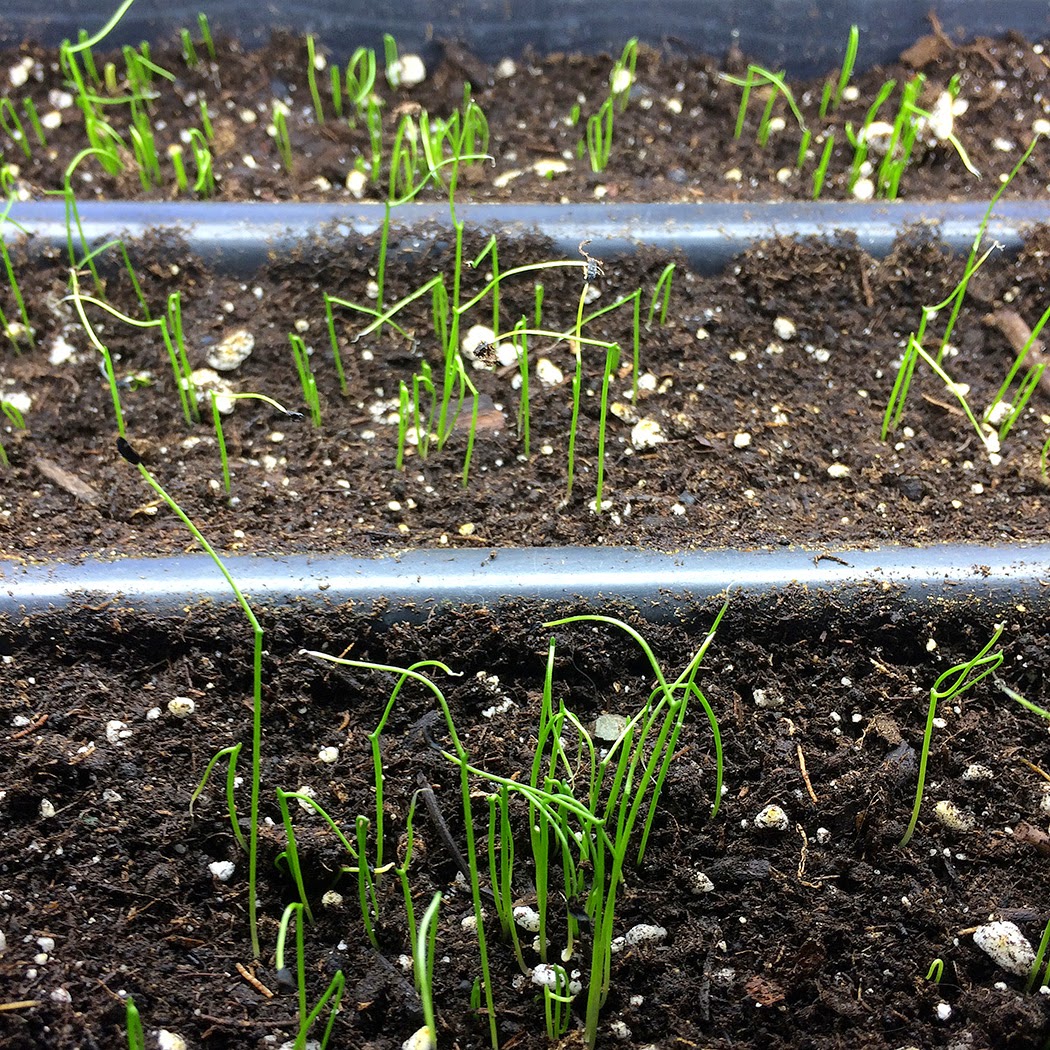
Chives growing away.

I also have a flat of chives under the grow light. I want to finish the chive hedge on the circle garden this year and between these new plants and being able to take divisions of what is there, I think I should be able to make it all the way around.

Gigante parsley, which is notoriously slow to germinate, is on the heat mat in the basement, but I don't expect to see anything popping up for a couple weeks.

Sweet peas when they had germinated sufficiently to be brought upstairs.

The sweet pea trial had an interesting outcome. Sort of. To refresh your memory, I took three seeds of two varieties of sweet peas: a Spencer variety for cutting—Lake Windermere—and an heirloom variety grown mostly for its scent—Fire and Ice. For each variety, I soaked one seed for 22 hours, nicked one seed and left one seed alone. Then I planted them in 4-inch pots (three per pot), heated them to between 60 and 65 degrees and watched for germination.

Here's when they germinated:
Day 6: Untouched Fire and Ice
Day 8: Untouched Lake Windermere
Day 10: Nicked Fire and Ice
Day 13: Soaked Fire and Ice

From there, Fire and Ice took off and Lake Windermere was stuck in time. The one seed that had germinated wasn't exactly thriving and the other two never germinated. Upon a close inspection, I found something crawling in the Lake Windermere pot and I'm pretty sure it was some kind of fungus gnat because the soil was too wet. That's the danger of using a larger pot with seeds ... it's very easy to make them too wet.

Fire and Ice is doing well enough to be ready for a little pinching back.

Because of that, I don't think this was really a fair trial, although I think the fact that the untouched seeds were the first to germinate in both pots suggests that you probably can't go wrong, no matter which way you choose to treat your sweet pea seeds.

I did sow another pot of Lake Windermere, so it will be interesting to see what happens with that.

The "real" sweet peas as well as Verbena bonariensis and several other things are scheduled to be planted next weekend. Good thing I ordered a bigger grow light!


Labels: , , ,

17 February 2015

EXPERIMENTS IN HORTICULTURE (WINTER BOREDOM EDITION)

I have a few horticultural experiments going on in my house right now. This is unusual for me because I rarely have the patience for such things, but this time of year calls for finding new things to amuse ones self.

All of the cuttings are currently residing in one pot, but if they root successfully I'll pot them on in their own personal pots. If it all works I should have trees in like 15 years. Ha!

About six weeks ago, maybe a little less, I took cuttings from the new white spruce (Picea glauca 'Hudsonii') we planted last year. So far it's been a lovely little tree and one I wouldn't mind having a few more of. It's the first time I've tried to propagate an evergreen and from what I've read, it will take up to 13 weeks for the cuttings to root, so I've not even tried to check on them yet. The good news is that they appear to still be alive in their little mini greenhouse (i.e. a plastic bag over the pot).

The cuttings live in their own mini greenhouse while they hopefully root.

If it works, I'll be sure to tell you what I did, but I don't want to share a method that is a failure if it doesn't work.

The other experiment going has to do with sweet peas. According to my little seed chart, sweet peas are not scheduled to be sown until March 15 at the earliest in my area, but I want to do everything I can to make sure that they are successful.

There is some debate as to how to start sweet peas. OK, there is a lot of debate involving everything from timing to the type of pots you should start them in to what to do with the seeds before you sow them. The last bit is what my mini experiment focuses on.

Some people say to soak the seeds. Other suggest nicking them. And several of the British gardening television presenters suggest doing absolutely nothing to them other than sticking them in the soil.

Blog reader Casa Mariposa reminded me to soak the seeds overnight and said hers sprouted in just a couple days by doing that. The growing instructions that came with my Owl's Acres Sweet Peas order (yeah, I'm the freak who orders seeds from England the first time I try to grow sweet peas) strongly suggest nicking or soaking, going so far as to say they don't recommend even trying them without doing one or the other.

Since I ordered too many seeds (I'll probably end up giving away whatever I don't use, so stay tuned if you're interested in that sort of thing), I'm starting six of them early. I took three of a Spencer variety (long-stemmed, meant for showing and bouquets) called 'Lake Windemere' and three of grandiflora 'Fire and Ice' and potted them up, one pot per variety (which is how I intend to sow them in March). For each variety, I nicked one seed, soaked another for 22 hours and did nothing to the third seed.
My sweet pea experiment is underway in the basement where the two pots are on a heating mat and cardboard makes sure that all light (not that there's much down there) is blocked.

The two pots are currently on the seed-starting mat (set to about 60 degrees but it's having a hard time getting to that temp for some reason, maybe because the pots are somewhat large) and I'll be keeping an eye on what happens.

Of course I'll report the results to you when I have some, which maybe be in a few weeks because it can take some time for sweet peas to germinate.


Labels: , , , , ,