The Impatient Gardener

26 September 2017

THE BEST PLANTS IN THE EARLY FALL GARDEN

It's an unsettling time in the garden. Part of me looks around, thinks about all the tasks that must get done before it gets too cold out to want to do them and wants to just get on with it, and the other part of me realizes that the garden is still looking fantastic. 

And a walk around the garden shows that the best looking plants right now are also, in general, among the easiest to care for. In fact, with one exception, the most I have deal with any of these plants is once a year. That's it. One tiny little bit of attention paid to them once.

Anything that requires that little care and provides this much pleasure is surely an all-star.

Korean feather reed grass is full of the most lovely fluffy flowerheads right now. The only thing I do to it is cut it back in late winter or very early spring. I supposed some day I'll have to divide it, but that's a rarity.


It provides a great backdrop to the thick, ruffly leaves of Gingko biloba 'Gnome'. Or is it the other way around?


Hydrangeas are the gift that keeps on giving. I can't imagine a garden without them. The panicle hydrangeas in particular shine at this time of year. This is 'Bobo', which is now in its fourth month of bloom (seriously, it started in June) and is now showing almost neon pink coloring.


'Quickfire' hydrangea has been pink for at least a month (hence the name), and is still looking great.


Hakonechloa is a good-doer all around, but 'All Gold' in particular shines in autumn light. Again, all I do to it is cut it back in late winter and I only divide it when I want more of it, which it happily provides.


Hakonechloa macra 'Stripe it Rich' gets great seed heads this time of year.


While all the plants around it are starting to look tattered, especially the slug-damaged hostas and the deer-munched 'Incrediball' hydrangeas, the groundcover Lamium maculatum 'Pink Chablis', seems to always look fresh and lively.


It wouldn't be early fall in the garden without Rudbeckia. It's the standard by which all fall-blooming perennials should be measured. I cut it back in spring, leaving the stems standing for the birds and winter interest.


Sedums just sit back as the unnoticed wallflowers all summer, but come early fall, they are stars. I also leave the standing over winter and I try to cut them back in about June to keep them a little stockier and prevent flopping.


Not all that is beautiful in the early fall garden is foliage or flower. These berries on Viburnun x juddii are so bright and shiny. I will enjoy them until the birds find them. I literally do nothing to this shrub other than admire it. What more can you ask for?


Roses hardly fall under the "low maintenance" category that the rest of these plants fall under, but it would be remiss of me to ignore them in a listing of the best plants in the garden in early fall. Here in zone 5, now is the time when most roses get a stunning second flush of flowers, so long as the gardener has been diligent about deadheading earlier in the year. This is 'The Alnwick Rose', which I planted in late spring.


Nature has a way of reminding us to enjoy every day and not rush to what's coming next. Plants like this are proof.


SaveSave

Labels: , , , , , ,

23 May 2017

HIGH SEASON FOR HOSTAS

Hostas, at least the ones in my garden, are just about at their peak. They thrive in the cool nights, (semi) warm days and constantly damp soil thanks to spring rains. The armies of slugs haven't hatched to attack them yet and so far the deer have been (mostly) thwarted by my preventative measures.

Their leaves are brilliantly colored and nary a stem is flopped. So perhaps it's no surprise that this is the time that I typically end up tinkering with them. Earlier in the season, when they are in their stubby-shoots-coming-up stage, I tend to forget just what they look like fully unfurled. But now my lousy gardener's memory is jogged.

I vowed this winter (at least mentally if not publicly) to be better about maintaining my garden this year, and that starts with doing some dividing and rearranging that I've put off for far too long. So this weekend I did a bit more of that, and I have to say I'm happy with the result.

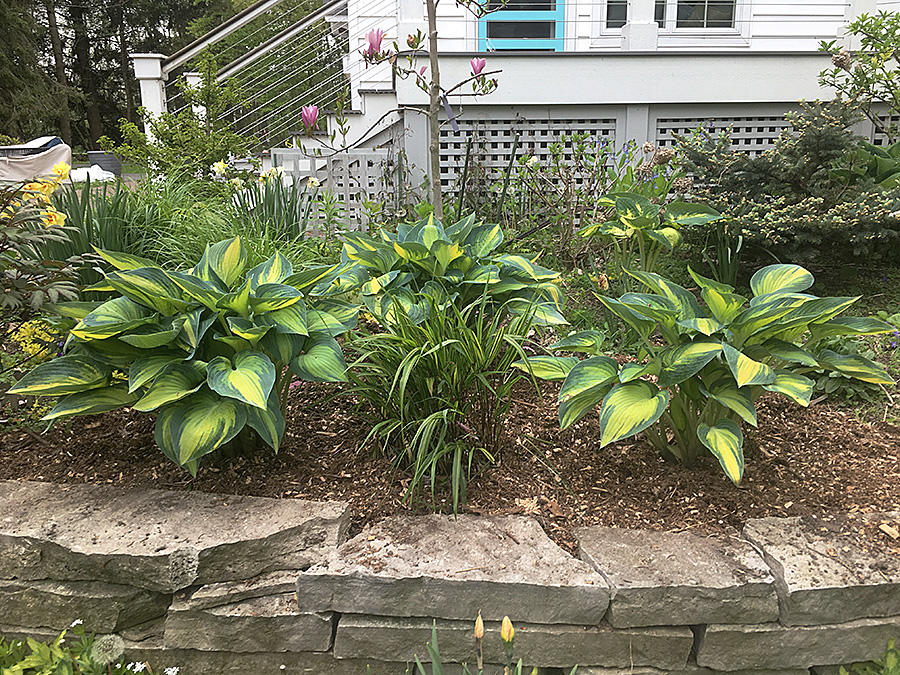
'June' hosta with 'Stripe it Rich' Hakonechloa after dividing
One 'June' hosta became three surrounding Hakonechloa 'Stripe it Rich'.

Since I made this video on how to divide hostas, lot of people have been asking me if it's too late to divide them now. The answer is an unequivocal no. In fact, you can technically divide them at anytime, but recognize that the more leafed out it is and the warmer the weather, the more you're going to have to water to counteract the stress it's been through.

Sunday afternoon I divided one of the Hakonechloa 'Stripe it Rich' grasses I grow in the east terraced garden. I've never seen that cultivar anywhere else but that plant grows so well in that half-day-of-sun situation. Originally there were three of them. One died, and the other two got quite big. My intention was to divide the remaining two (making for plants total), replant the third of the trio that had died and move the other division elsewhere in the garden. It's a good thing I started with the middle one because that thing was a beast to dig up and divide.

'Autumn Frost' hosta after moving
'Autumn Frost' in it's new home. I don't know a hosta that is more beautiful in spring.


After that bit was done, I moved two of the hostas that surrounded the center grass. One was 'Autumn Frost', which I consider to be the single best looking spring hosta that has ever been grown on the face of the planet, and another is an unknown. The third was 'June', which is certainly in my top five favorite hostas. 'June' had gotten quite large, so I decided to divide it into three and replace the moved hostas, although space things out a bit more to accommodate growth better than when I originally planted there.

'June' hosta

If I thought the grass was difficult to dig up, I clearly had no idea what 'June' had in store. In fact Mr. Much More Patient was called into rare garden service to grab a shovel and dig/pry opposite me. (In case you were wondering, he's been well trained for these moments, starting with "What is safe to step on here." He's a good man.) The root ball was so big I had to have him help me roll it out of the hole. Things were much more manageable once 'June' was finished with surgery and I'm happier that it's a bit more of a cohesive look there.

That job, which ended up taking well over an hour, was certainly not the only thing I did in the garden this weekend, but it probably brings the most satisfaction. And it's one more way I justify not having to go the gym. Crossfit has nothing on hosta dividing.


Labels: ,

17 March 2017

FINDING A FOCAL POINT

Big things happen in my garden when I'm not able to garden. It is absolutely a case of my gardening eyes being much larger than my gardening stomach, but what else is a gardener to do during the long days of winter than think about the garden?

The west side of the house is the first part you see when you drive in.

This spot along the west side of the house has been problematic over the years. First I grew a very questionably hardy Japanese maple there (it died; I was sad). Then I planted a rather ordinary witch hazel there as the focal point. Unfortunately I was at the mercy of local nurseries, which seem to stock the most plain-Jane cultivars they can find, and ended up with a not-so-special plant. The best that area has looked was in the early days of the planting there. The witch hazel was small but lush, in front of it were black Heucheras and on the edge was a swatch of Hakonechloa 'All Gold'. 

The second year after planting this area was looking pretty good (minus the creeping Charlie problem in the lawn).

But the Hakonechloa happily took off and the Heuchera, which is not long lived in my garden to begin with, suffered. It's still there, it's just much shorter than the Hakonechloa, so you can't even see it. I divided all that Hakonechloa three years ago to make the new garden by the garage and I'll be able to divide it again for the new circle garden this year. Despite being considered a shade plant, it thrives in that spot with just a big of fading late in the summer. It's an all-star in my garden, seemingly accommodating a variety of light conditions.

But several years later it's less of a success.
Clearly this spot is in need of a bit of a redo. The good news is that because of the large spruce we cut down on the south side of the driveway there will be more light on this side of the house. Also, it's really more of a west southwest exposure, so there is light there by late morning. You can get a feel for the layout of the garden—this space is labeled as the "West side garden"—in the slightly outdated "artist's rendering" of the garden that I did a few years ago, below.


The most important part of that planting, and frankly, perhaps one of the most important parts of the entire garden as it is visible as you drive in, is the focal point plant in front of the chimney. In my opinion, it needs to be highly structured and a little simple so as to not compete with the busy pattern of the stone. I've been wary of dark foliage because I want it to stand out against the dark of the chimney.

A month or ago I took Margaret Roach's 365-day garden webinar. It was very good and full of valuable information but the only thing I can tell you about it right now is that Margaret has an Asian pear espalier on the side of her house and I'm in love. I would love to link you to a picture of it but I can't find one that links back to Margaret's page, so you'll have to trust me that it's fabulous. I've been obsessed with the idea of doing an espalier tree in front of the chimney ever since and that led to a ferocious amount of calling around to local nurseries. 

The good news is that I found one not far away and they claim to be reserving it for me (I always wonder if nurseries are really saving plants though as they never take a deposit and it all seems very casual). Supporting it will requiring putting bolts and wires in the stone or mortar. Obviously a full southern exposure would be best, so fruiting may be slightly compromised but that's OK. I'm frankly more worried about aesthetics than production and would have been equally happy with a non-fruiting espalier if one were able to be located. 

I will leave the Hakonechloa after dividing in hopes that it can handle the increased amount of sun, but the Heuchera will be replaced. With what, I don't know. But it feels good to go in to gardening season with a plan. 


Labels: , , , ,

01 August 2014

FIVE PERENNIALS I'D NEVER BE WITHOUT

I have had a lot of favorite/top posts in the works and was planning to run them over the course of a week, but this is my 600th post on this blog so I thought it should be something a bit meatier, and today I'm bringing you five perennials I wouldn't be without.

These are plants that are complete no-brainers for me and I can't fathom having a garden without them. Most of them are low maintenance and therefore play an important role in my zone 5b garden.

1. LADY'S MANTLE (ALCHEMILLA MOLLIS)
My adoration for this plant know no bounds. It has a lovely scalloped round leaf and a very clumpy habit, so even when it has put on a lot of growth it tends to stay in a tight ball. The leaves are slightly fuzzy so critters don't bother it. In early summer it sends up shoots of tiny chartreuse flowers that last for months, although they tend to flop over. The flowers are wonderful in flower arrangements but equally as nice in the garden where they add an ethereal shot of light.

Lady's Mantle: A perennial I wouldn't be without

Lady's Mantle: A perennial I wouldn't be without

Lady's Mantle: A perennial I wouldn't be without

In my garden, Lady's Mantle grows equally well in full sun and part shade, although the flowers seem to last a little longer in shadier spots. It couldn't be easier to divide, something I have done at almost any time of the spring and summer. It will also seed itself sometimes, but in my garden it does this only in the nicest possible way and is not at all overbearing.

Dwarf Lady's Mantle
Dwarf Lady's Mantle (Alchemilla enthropoda) is truly petite, but its scalloped foliage is so charming.

The past couple of years, I have added a dwarf version of the plant to my garden (Alchemilla enrthropoda). It doesn't flower nearly as well, but its leaves are utterly charming and perfect for the very front of a border.

2. NEPETA
Nepeta, aka Catmint, is a true workhorse in the garden, especially for someone like me who can't get enough of anything with a blue(ish) flower. There are oodles of varieties out there and my preference is for those that don't seed themselves everywhere. Walker's Low became quite popular a few years ago and I quite like it, although it is not a small version as the name would suggest.

Nepeta: A perennial I wouldn't be without

Nepeta: A perennial I wouldn't be without
Nepeta 'Walker's Low' loosens things up by the meatball boxwood.

I line my path with Nepeta, sort of a poor man's substitute for lavender (which I've had no luck with in the past). When it gets too floppy I cut it all back to about 6 inches off the ground and it regrows and reblooms in about a month. Last summer I got three full rounds of blooming.

It's another plant that no critter will eat and the bees adore it. I also love the smell of it, making it an even better selection for the path, where you may brush against it. I've also dotted it liberally around the garden where it has a tendency to flop a bit and intermingle with its neighbors, usually creating a lovely look.

3. HOSTA
Given my recent complaining about how I have almost no intact hostas left this year, thanks to an aggressive deer and slug population, you might be surprised to find this stalwart on my list. Unlike the previous two plants, I'll admit, hostas have some drawbacks. But there's a reason that there are people out there who call themselves hostaholics; who have thousands of different cultivars in their back yards. Hostas provide an important texture that few other hardy plants can. With all the bitsy plants with minute leaves, there are precious few that can juxtapose them, and hosta does it better than almost any other. They can have an almost tropical feel to them.

Hosta: A perennial I wouldn't be without
Elegans and Paradigm hostas play well together. In the photo below, you can see a little 'Silver Moon' clematis growing up the lattice in bright shade.
Hosta: A perennial I wouldn't be without

Of course hostas come in just about every shape, size and color (white, yellow, green and blue and everything in between) you can imagine, so it's easy to understand how you could quickly fill a garden with them.
Hosta: A perennial I wouldn't be without

In my zone, you can find a hosta to grow almost anywhere, including full sun. Some (usually yellows) do better than others in sunnier spots and you probably need to water them more, but I'm always amazed at how tough hostas can be.

4. CLEMATIS
I'm throwing this vine in this group purely because I have become somewhat obsessed with them. These are nowhere near as carefree as the other plants on this list, but I don't think they are as high maintenance as most people think they are. If you plant them right to begin with—deeply in a hole filled with good stuff including compost, well-rotted manure and a touch of bone meal—water it well and mulch them to keep the roots from frying, all you really have to do the rest of the year is a little pruning and throw on a bit of fertilizer (I use Espoma's Rosetone).

Clematis: A perennial I wouldn't be without
Etoile Violette, a group 3 clematis, climbs up the deck railing.
Etoile Violette Clematis: A perennial I wouldn't be without

Although I love, and have fallen for over and over again, the large group 2 clematis with their showy flowers, these require more work than the others. The smaller flowers in group 3 are utterly charming when they work their way through a shrub or tree and and are so easy to care for: just cut them back to one or two buds in very early spring.


Clematis: A perennial I wouldn't be without
This one is just crudely tied to a stake amid a forest of monarda.

Awhile ago, I figured out that you don't need a trellis to grow clematis. I now grow them up shrubs and trees, on standalone obelisk-type things (sometimes just a group of skinny tree branches), sprawling on the ground, and up the deck railings. I like it when they go a little wild.

5. HAKONECHLOA
Originally I thought I would choose ornamental grasses for this last slot, but that is a pretty broad category, so to narrow it down I'm going with Hakonechloa (Japenese forest grass). It grows in shady spots where most other grasses won't even think about going, but it will tolerate a fair bit of sun as well. With a lovely arching habit it has a way of softening the edge of a border. And it looks great with hostas because of the contrast in foliage types.

Hakonechloa: A perennial I wouldn't be without
'All Gold'

My favorite is 'All Gold', but I also grow 'Stripe it Rich', 'Beni Kaze', and 'Aureola' (all of which look very similar to me).

Hakonechloa: A perennial I wouldn't be without
'All Gold' mixes well with black heuchera.
Hakonechloa: A perennial I wouldn't be without
'Aureola'
What perennials would you never be without? Did any of mine make your list?


Labels: , , , , , ,

13 June 2013

The Garden Appreciation Society Week 5

Sorry for the delay on getting The Garden Appreciation Society Week 5 up. You know work, and then I, well, forgot and then yada, yada, yada. (I don't think anyone else is still yada, yada, yadaing but it's really such a useful device, don't you think?)


It continues to be a challenging time to find something for me to make a bouquet out of, but the fact that I did again I think proves what this is all about: there is ALWAYS something to appreciate. Still, I love for the week when I can just cut a handful of zinnias.

This week I went with stuff that I never would have thought about putting in a bouquet, including Ligularia (possibly 'Desdemona') and Hakonachloa 'All Gold'. The two alliums are obvious additions but are a great examples of flowers I never would have cut before. I don't have many and it's difficult for me to cut them to bring them in. I have used the bleeding heart (Dicentra spectabilis 'Gold Heart') before, including the foliage last week and have found that it holds up really well. Now that it's in bloom I had to put some in the bouquet.

Can you tell I have a thing for chartreuse foliage? Looking around the garden I've been noticing I have a good amount of it spread throughout the garden. I think one can go overboard with that, but I don't think I'm there yet.

The Impatient Gardener Garden Appreciation Week 5 (Ligularia, Hakonechloa, bleeding heart, allium)

The Impatient Gardener Garden Appreciation Week 5 (Ligularia, Hakonechloa, bleeding heart, allium)

The Impatient Gardener Garden Appreciation Week 5 (Ligularia, Hakonechloa, bleeding heart, allium)

The Impatient Gardener Garden Appreciation Week 5 (Ligularia, Hakonechloa, bleeding heart, allium)


Now that you've seen it looking good, I have to unfortunately report a couple items. The Ligularia leaves completely pooped out and the cat (named, you may recall, Desdemona) passed those up but LOVED the the grass so most of that was pulled out and stuck back in again.

You all came up with such beautiful bouquets for Week 4. I have to say I'm more than a little envious of some of your flowers (particularly the gardenias), but I am so enjoying see everyone's ways to appreciate their gardens in a new way.

Please link up this week. I'll leave the link open a little longer because of the late start.

And check out the great links from past weeks as well:

Labels: , , ,

30 November 2011

Fleeting color

I was downloading some photos from the weekend Tuesday night and realized there were a few I'd taken just a couple weeks ago that I've not posted. One of the amazing things about living up north, where the seasons mean business, is how quickly things change. Although we've not had any snow yet (which is pretty surprising), it's been plenty cold and the color is gone from the yard. Even the grass is taking a decided turn for brown.

But I had to share a couple of these from just a couple weeks ago.
I don't think you could ask for anything more from a tree beyond what Acer japonicum 'Acontifolium' gave me this fall.

Leaves

And Hakonechloa 'All Gold'  has grown into a beautiful, bushy little mound that turned even brighter yellow this fall and got great seed heads on it. This is one plant I love to leave standing all year because it adds great interest even in winter.

Leaves2

Sigh, I miss it already.

Labels: ,

01 October 2010

You know your house is a mess ...

When even the plants are dirty.

My Hakonechloa 'All Gold', Heuchera 'Blackout', and new witch hazel all got a heavy coating of dust when the masons were out fixing the chimney. Guess I'll have to wash my gardens this weekend since rain isn't predicted for awhile.

Photobucket

Photobucket

Photobucket

Labels: , ,

14 May 2009

Hidden gems

There are a couple nurseries I shop at regularly where the staff are extremely well versed in plant care and selection. I know when I go to these places that the plants I'm buying have been well cared for and provided I don't do anything stupid, they should be fine in my garden.

But there a couple other places I look for plants. One is a major big box home improvement store and the other is the local hardware store. I never go to either of these stores specifically for plants (unless I'm bored) but I do love looking through the racks for a special gem. The big box store takes horrible care of its plants, so its important to try to get there within a week of delivery. A friend told me she picked up some Hakonechloa, so I had my eye out for it. Well it's a good thing I had that in the back of my head. Near a pile of unnamed hostas (which I think is really criminal because hostas have great names and even if you don't care which one it is, everyone should be able to enjoy its name) was a cart full of random plants. And way on top were the Hakonechloa: about four flats of them. Of course they were being cooked in the sun, but most of them were in good shape. I snatched up three of them for $8.99. They were a nice size, and frankly that plant has been hard to find (which makes no sense since it's the perennial of the year).

The local hardware store does a much better job caring for its plants, but lacks some of the technical know-how about them. They don't sell a lot of perennials and what they do have tends to come in numbers of just two or three, so it pays to get there
shortly after a delivery. (Fortunately I drive by every day to and from work so I keep an eye on the plant racks). There is no rhyme or reason to the plant organization. They just line them up on the rack. Sometimes the shade plants end up on the top row (occasionally I'll rescue a heuchera for them and set it somewhere a little less harsh). To really see what is all on the rack you have to do some rearranging and I usually investigate the back of the rack by squinching in between pallets of bagged mulch. That was a tactic that worked great last week as I found a beautiful Japanese painted fern in the middle of the mess. I also picked up a couple of Ligularia Britt-Marie Crawford.

The funny thing about this is that this kind of plant shopping is not unlike picking through the racks at a department store sale, which I HATE. I get bored and frustrated, and never leave with anything that I really like. Guess I'm just better at plant shopping than clothes shopping.

Labels: ,